Website architecture determines how Google discovers, crawls, and ranks your content. The choice between silo structure and flat site structure changes how link equity flows, how crawl budget gets allocated, and whether your money pages capture the topical authority they need to rank.
Architecture is one input into a bigger system — see our complete guide to internal linking strategy for the full framework.
In our analysis of agency implementations, architecture choice correlated with a 34% variance in topical keyword performance. Sites with clear structural organization consistently outperformed structurally disorganized competitors, even when content quality and backlink profiles were similar. Architecture changes are also large enough to measure cleanly, which suits the before-and-after approach in our guide to SEO testing for agencies.
Why Site Architecture Drives Rankings More Than You Think
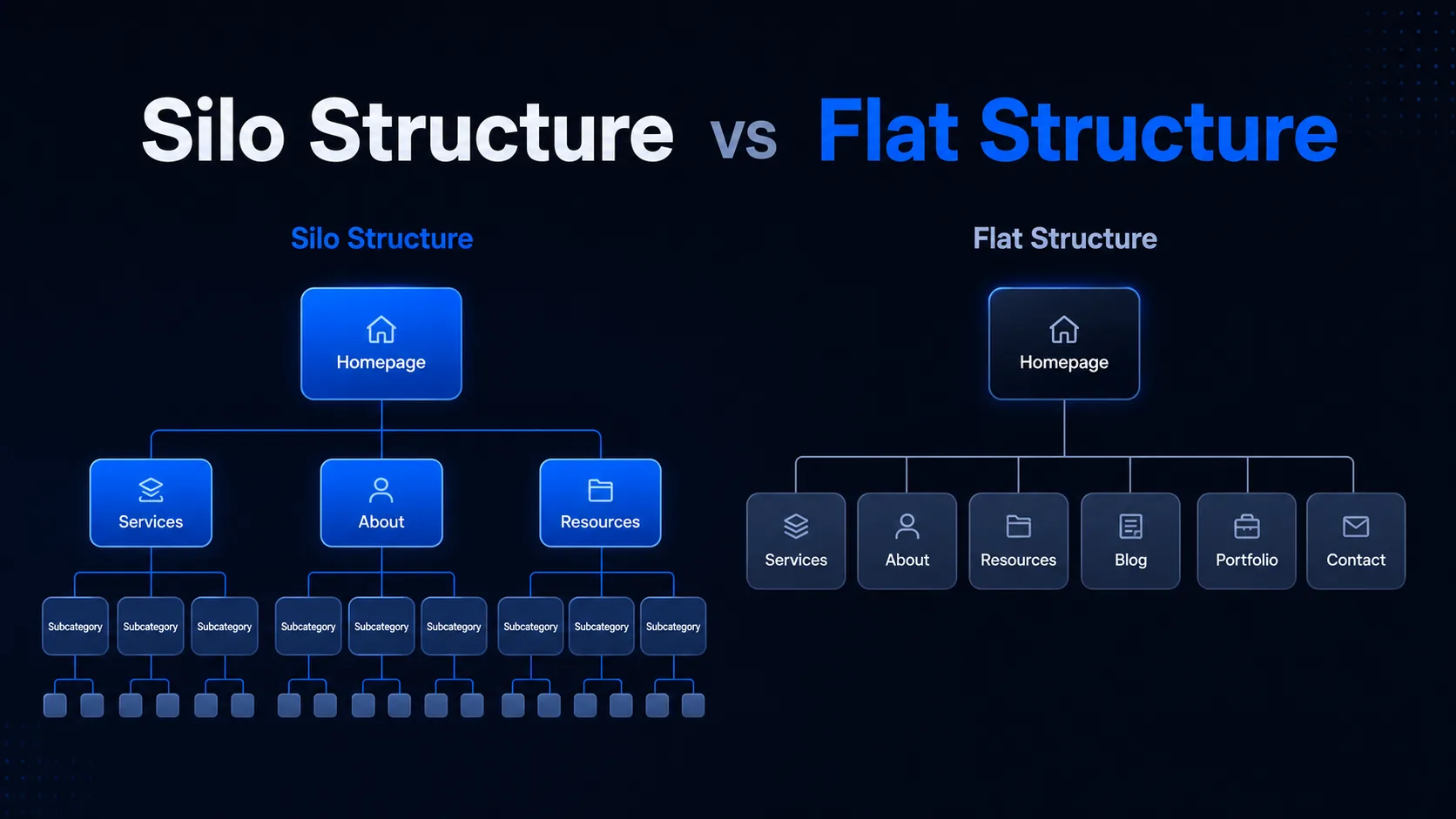
Google's crawl budget is finite. Your information architecture determines which content gets discovered, how quickly new pages get indexed, and which pages receive enough crawl attention to rank. Flat architecture places everything within 1-2 clicks of the homepage, maximizing crawl accessibility but diluting topical focus. Silo structure creates hierarchical organization with clear subject boundaries, concentrating authority signals but requiring more disciplined internal linking.
The post-Helpful Content Update landscape rewards demonstrable expertise. Google's algorithms evaluate whether sites show clear subject matter authority in specific topics. Architecture communicates that focus through URL structure, internal link patterns, and content grouping.
How Google Crawls Different Website Navigation Structures
When Googlebot encounters a flat site structure, it sees a site where most pages are equally accessible from the homepage. This democratic structure means every page has similar crawl priority, which works well for small sites but creates inefficiency at scale.
Silo architecture creates clear signals about page importance through hierarchy. Category pages receive more internal links than individual articles. Hub pages connect to related content within their topic cluster. This structure tells Google's algorithms which pages represent core expertise and which provide supporting detail.
Sites with structured content organization show 40-60% faster indexation for new pages within established content silos compared to new pages added to flat architectures.
Common Architecture Mistakes That Kill Rankings
The most common architectural mistake isn't choosing the wrong structure—it's implementing site hierarchy inconsistently. Sites that start with silo organization but allow convenience linking to break topical boundaries confuse Google's topic modeling.
Flat architectures fail when they grow beyond 500-1,000 pages without introducing organizational structure. The homepage becomes a bottleneck, trying to link to too many pages simultaneously. Crawl efficiency drops because Google must evaluate masses of undifferentiated content without clear hierarchy signals.
The third mistake is over-siloing. Creating so many narrow topic categories that related content sits in isolated clusters when Google's algorithms expect broader topical coverage.

Understanding Silo vs. Flat Architecture Core Definitions
What Is SEO Silo Architecture Structure?
SEO silo architecture organizes website content into hierarchical topic clusters where related pages group under category parents with restricted cross-category linking. The core principle: concentrate topical relevance signals by keeping internal links flowing vertically within topic silos rather than horizontally across them.
Silo structures consist of three layers:
Category/hub pages at the top that define the topic and link to all subcategory and article pages within that silo
Subcategory pages that organize specific topic segments and link to related individual articles
Individual content pages that link back up to their parent categories but minimally to pages in other silos
Physical silos use URL structure to create hierarchy: example.com/category/subcategory/page. Every level of the URL path represents a deeper topic drill-down.
Virtual silos maintain flat URL structures like example.com/page-name but create topical organization through strategic internal linking patterns. Pages within the same topic cluster link heavily to each other and their hub page, while cross-cluster links are minimized.
Hybrid approaches combine both methods. Using URL structure for major category divisions while relying on internal linking to create more granular topical clusters within those categories.
The distinguishing characteristic: link equity concentrates within topic boundaries. When a product page in your "email marketing" silo earns backlinks, that authority primarily benefits other pages in the email marketing silo, not your unrelated "social media" content.

What Is Flat Site Architecture?
Flat architecture minimizes hierarchy by placing most or all pages within 1-2 clicks from the homepage. Rather than nested categories and subcategories, the navigation resembles a broad, shallow web where navigation emphasizes accessibility over topical grouping.
In its purest form, flat site structure features:
No URL folders or crawl depth: All pages exist at the root level (example.com/page-name)
Homepage links to everything: Primary navigation reaches most important pages directly
Liberal cross-linking: Pages link to related content regardless of topic boundaries
Minimal hierarchical parent-child relationships: Every page is equally accessible
Flat structures prioritize user convenience and crawl efficiency over topical authority signals. Google's crawler can reach any page within 2-3 hops from the homepage, ensuring comprehensive indexation.
Link Equity Distribution Comparison
Architecture Type | Link Equity Distribution | Authority Concentration | Best For |
Silo Structure | Backlinks strengthen entire silo's topical relevance | Strong signals for competitive keywords within each silo | Sites competing on specific topic expertise |
Flat Architecture | Backlinks distribute authority evenly across site | Broad but shallower authority distribution | Sites competing on overall brand authority |
Hybrid System | Targeted concentration for money pages, broader for supporting content | Balanced approach with flexibility | Most established sites with diverse needs |
The tradeoff: silos concentrate power at the cost of implementation complexity, while flat architectures offer simplicity at the cost of topical focus.
How to Choose Between Silo and Flat Architecture
Architecture selection depends on four factors: site size, content organization complexity, competitive landscape, and available technical resources.
Which Website Structure Is Best for Your Industry?
E-commerce sites benefit from silo structure when product catalogs exceed 200 SKUs. Category hierarchies mirror how customers mentally organize products, ensuring category pages accumulate topical authority for competitive product searches. For boutique stores with fewer than 50 products, flat architectures work well.
For the full category-to-product linking playbook at scale, see our guide to internal linking for massive e-commerce sites.
SaaS and B2B sites perform best with hybrid approaches. Silo organization works for feature documentation, creating product → feature category → individual features hierarchies. Use-case content and industry solution pages work better in flatter structures that encourage cross-solution discovery.
Local multi-location businesses should implement location-based silos when serving 3+ distinct geographic markets. The structure becomes City → Neighborhood → Service pages, with each location silo maintaining independent topical authority for geo-targeted searches.
Content publishers face the silo-vs-flat decision based on whether topical authority or recency drives their SEO strategy. Authority sites building pillar-cluster content hubs benefit from silo organization. News and timeliness-focused publishers maintain flatter structures where homepage prominence drives traffic.
Website Architecture Best Practices by Site Size
Site Size | Recommended Architecture | Key Consideration |
Under 100 pages | Flat Site Structure | Simplicity advantages outweigh topical authority benefits |
100-1,000 pages | Hybrid System (transition zone) | Choose silo if content divides into 4-8 distinct topics with minimal overlap |
Over 1,000 pages | Silo or Structured Hybrid | Hierarchical organization essential for crawl efficiency |
10,000+ pages | Multi-tiered Silo Structure | Requires staged implementation to avoid overwhelming crawlers |
When your site crawl takes longer than 2-3 hours or Google Search Console shows declining index coverage despite quality content additions, architectural organization problems are the root cause.
Comparing Architecture Scalability
Flat architectures scale linearly. Every new page adds similar complexity to navigation and internal linking. This predictability makes maintenance straightforward but becomes unwieldy past 500-1,000 pages.
Silo structure scales hierarchically. Adding content within existing silos is straightforward, but creating new silos requires careful planning. The scalability sweet spot: sites with 4-8 stable primary topics that will deepen rather than broaden over time.
Content velocity impact: Sites publishing 10+ articles weekly need architectural plans that accommodate rapid growth. Silo structures with well-defined category hierarchies handle high-volume publishing better than flat structures that require constant navigation updates.
How to Select the Best Architecture Solution for Your Site
Choose silo architecture when:
Targeting 3+ competitive topic areas where topical relevance determines rankings
Content naturally divides into distinct subjects with minimal legitimate overlap
You have technical resources to maintain silo integrity as the site scales
Category and subcategory pages serve as valuable ranking targets themselves
Choose flat architecture when:
Site has fewer than 200 pages with limited growth plans
Content interconnects heavily and artificial topic boundaries would hurt user experience
Quick implementation and minimal ongoing maintenance are priorities
You're competing on overall brand authority rather than specific topic expertise
Consider hybrid architecture systems when:
You need topical organization for some content but flat accessibility for other sections
Main product/service pages benefit from silo structure while supporting content works better in flatter organization
You're retrofitting architecture onto an established site where full silo implementation isn't practical
Internal Linking Strategy Requirements by Architecture Type
Silo architectures require ongoing link audits to ensure content creators don't inadvertently break silo boundaries with convenience cross-links. This adds 4-6 hours monthly for sites with 500+ pages and active content publishing.
Not sure where your current links stand? Start with our guide to auditing your website's internal link structure.
Flat architectures offer linking flexibility but require different discipline: ensuring high-priority pages receive sufficient internal links from related content. Without hierarchical structure providing natural link patterns, flat sites need documented linking protocols.
Check out RankNest's internal link visualization tool. For the wider category, see our comparison of the best internal linking tools for agencies.
How to Implement Silo Architecture Successfully
Architecture changes require methodical execution to avoid ranking disruption and ensure long-term maintainability.
Migrating from Flat to Silo Structure in Four Phases
Phase 1: Architecture Planning & Content Mapping (Week 1-2)
Audit current content and group pages into logical topic clusters. Identify which pages will become category hubs, which fit as subcategories, and which work as supporting articles. Map the new URL structure and internal linking patterns before making any technical changes. If you want to measure whether the migration helped after it goes live, use one of the best SEO testing tools in 2026 to run a before-and-after test on the changed pages.
Create a comprehensive content inventory spreadsheet documenting every existing page's current URL, target keyword focus, current internal link count, and organic traffic.
Phase 2: URL Structure & Redirect Strategy (Week 2-3)
For physical silos requiring URL changes, create the new hierarchy and implement 301 redirects from old URLs to new locations. Batch redirects by topic area and implement gradually. Spread major redirect implementations across 2-4 weeks to avoid overwhelming crawlers.
Use server-level 301 redirects (Apache .htaccess or Nginx configuration) rather than meta refresh or JavaScript redirects.
Phase 3: Implementation & Internal Linking Strategy (Week 3-6)
Restructure internal links to respect silo boundaries. Every existing internal link needs evaluation to determine whether it fits the new silo structure or should be removed. Prioritize fixing links on high-authority pages first.
Add new hub pages and ensure every silo has a clear category page that links to all child pages within that topic cluster. Implement breadcrumb navigation that visually reinforces the hierarchical structure.
Phase 4: Monitoring & Recovery (Week 6-12)
Expect ranking fluctuations during weeks 2-4 as Google recrawls your restructured site. Most sites see a temporary 10-20% traffic dip that recovers by week 6-8. Monitor Google Search Console's Index Coverage and Page Indexing reports to catch any pages that failed to get recrawled.
Sites recover to pre-migration traffic baselines within 6 weeks and show meaningful ranking improvements (15-30% traffic increase for priority topics) by months 3-4 as topical authority signals strengthen.
Migration Risk Mitigation Best Practices
The primary risk during architecture migration is temporary ranking volatility caused by link equity distribution changes. Minimize this risk by maintaining historical internal link patterns for your top 20% highest-traffic pages during the initial migration phase.
Crawl budget protection: Large sites (10,000+ pages) should implement migration in geographic or topical batches rather than site-wide simultaneously. Migrate one complete silo, monitor for 2-3 weeks until rankings stabilize, then proceed to the next silo.
Platform-Specific Silo Structure Implementation
WordPress silo implementation:
Use category taxonomy for physical silos. WordPress categories create URL hierarchies automatically. Assign each post to one primary category to maintain silo integrity. Limit category nesting to three levels maximum.
Configure WordPress permalinks to include category structure (/%category%/%postname%/) rather than date-based or plain permalinks. Install a breadcrumb plugin (Yoast SEO or RankMath) and place breadcrumbs above post titles to reinforce hierarchy visually.
Shopify silo architecture:
Shopify's collection hierarchy limits silo depth to 2 levels (main collection → subcollection), which works for most e-commerce implementations. Use metafields and automated collections to create virtual silos when you need more granular organization.
Organize products into benefit-focused or use-case collections rather than generic product-type collections.