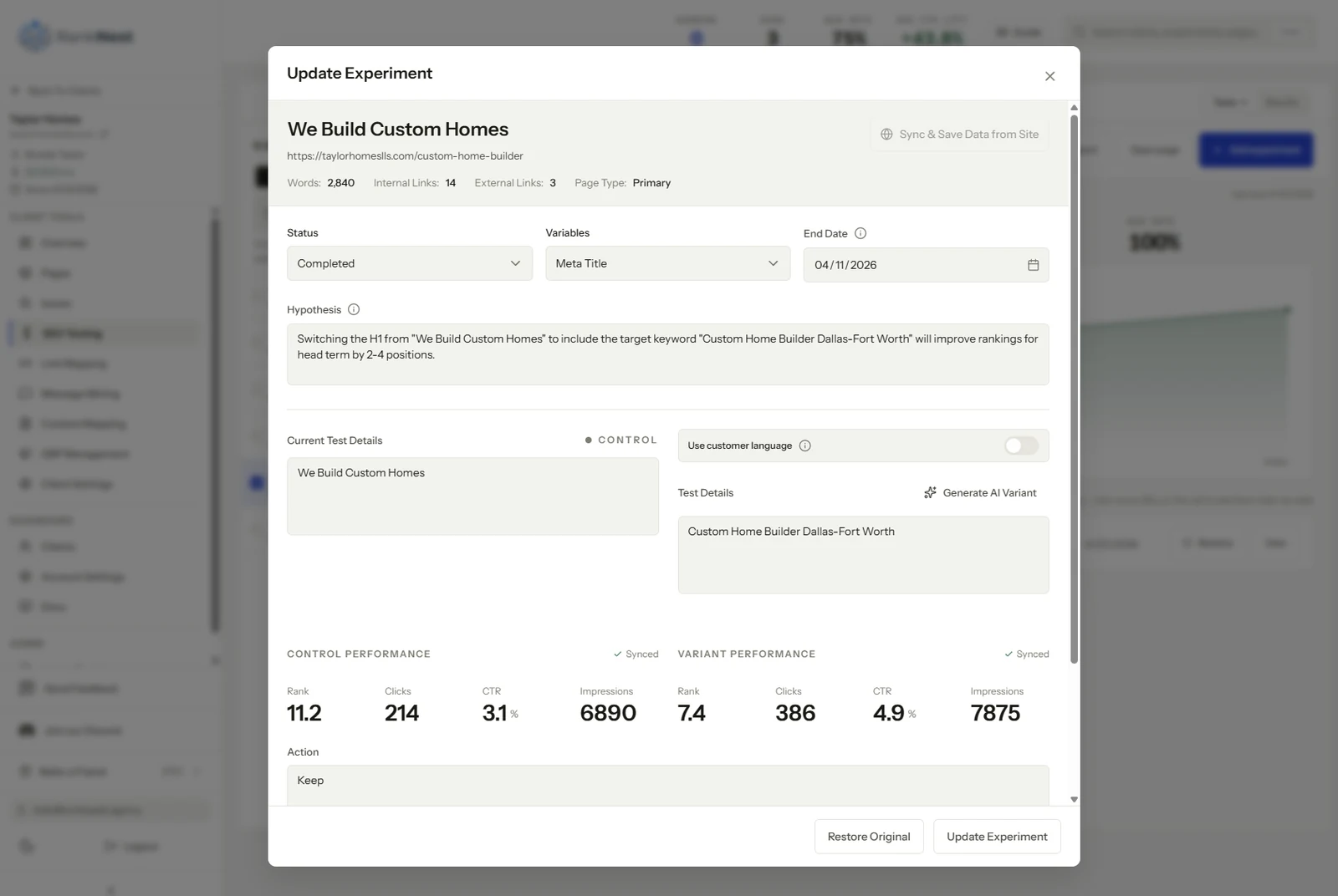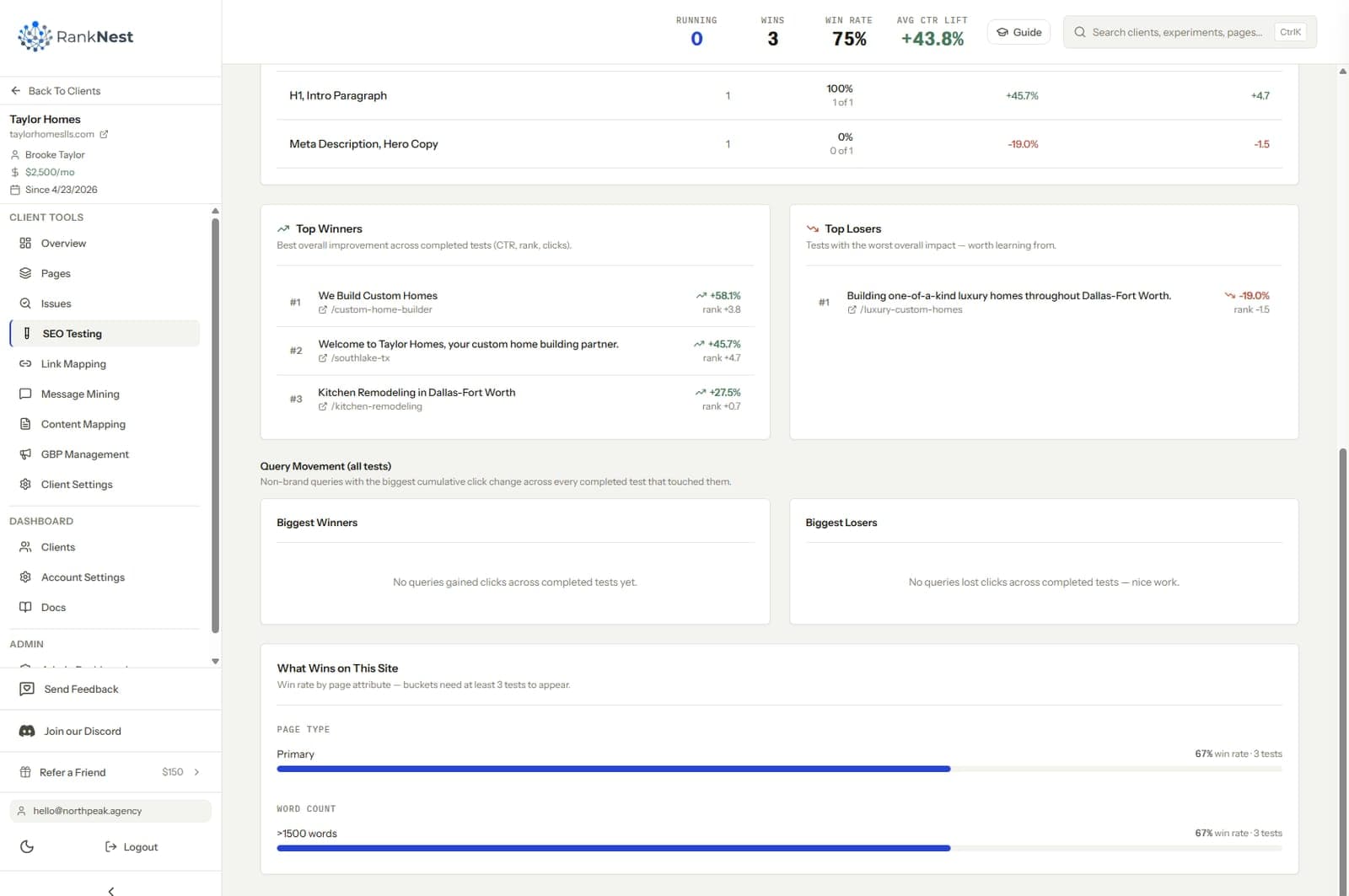
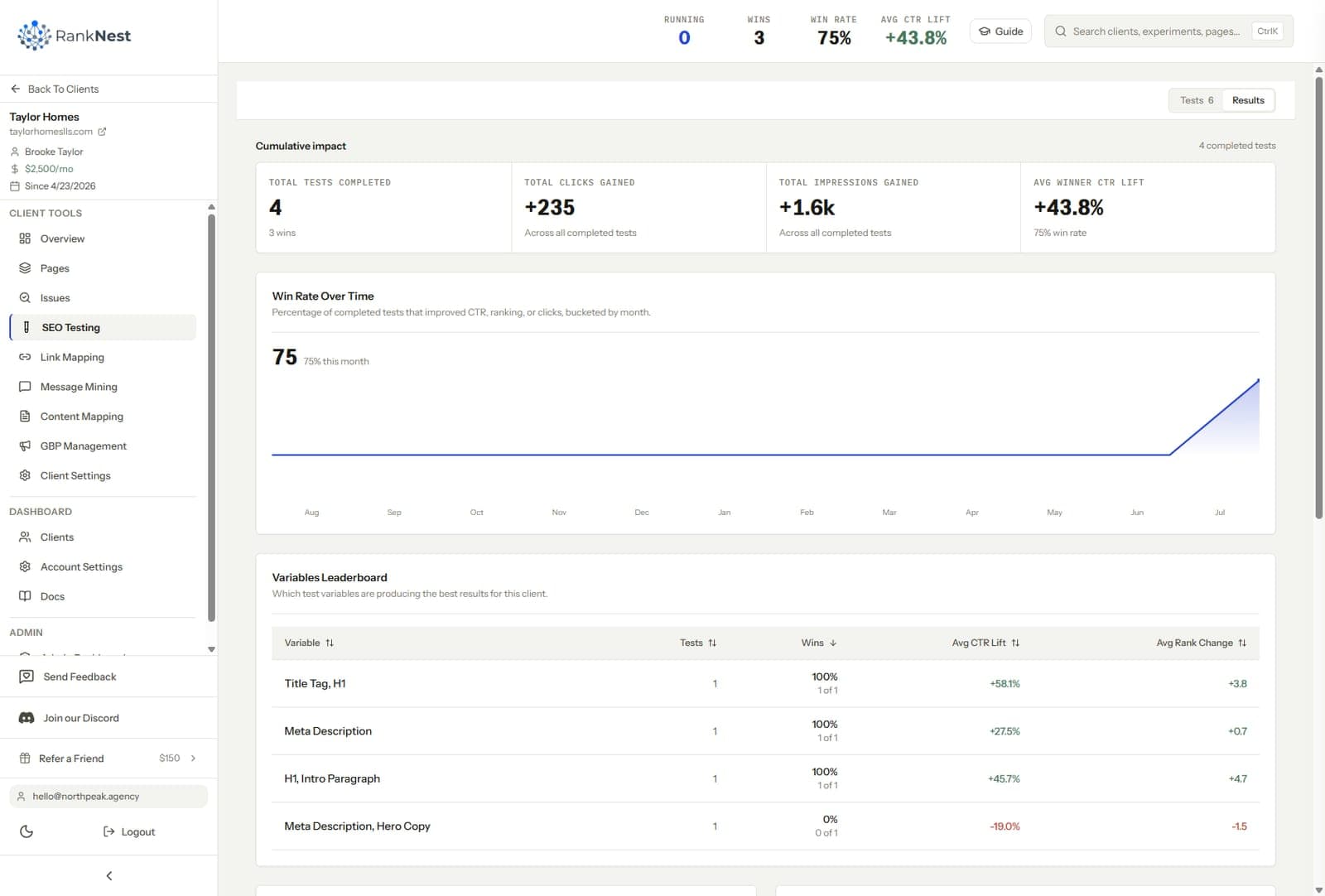
Proving SEO ROI to clients means showing causation, a specific change you made, the measured before/after effect, and what that effect is worth in the client's revenue terms. Dashboards cannot do this. A traffic graph going up shows correlation at best, and the client knows it, which is why the graph buys you exactly one bad month of goodwill. An experiment log, each change dated and measured against a Google Search Console baseline, is evidence that survives renewal conversations.
This post covers how to build that evidence, how to translate it into the client's money, and what to actually say when a client asks whether SEO is working.
Why dashboards fail at retention
Every reporting tool on the market sells the same promise, beautiful client dashboards. And every agency owner knows the ritual, the client opens the dashboard twice, then stops, then asks in month 7 what they are paying for while the dashboard shows rankings up 30 percent.
The problem is attribution. A dashboard shows outcomes, and outcomes have many parents. Rankings rose, but the client also got 12 new reviews, ran a radio spot, and Google shipped a core update. The client cannot tell your contribution from the noise, and privately, neither can you.
Dashboards also fail in the other direction, which is worse. When an algorithm update knocks traffic down 15 percent, the dashboard convicts you of a crime you did not commit. You have no change log to point at, so the whole channel takes the blame, and the retainer goes under review.
Correlation gets questioned. Causation gets renewed.
The unit of proof is one measured change
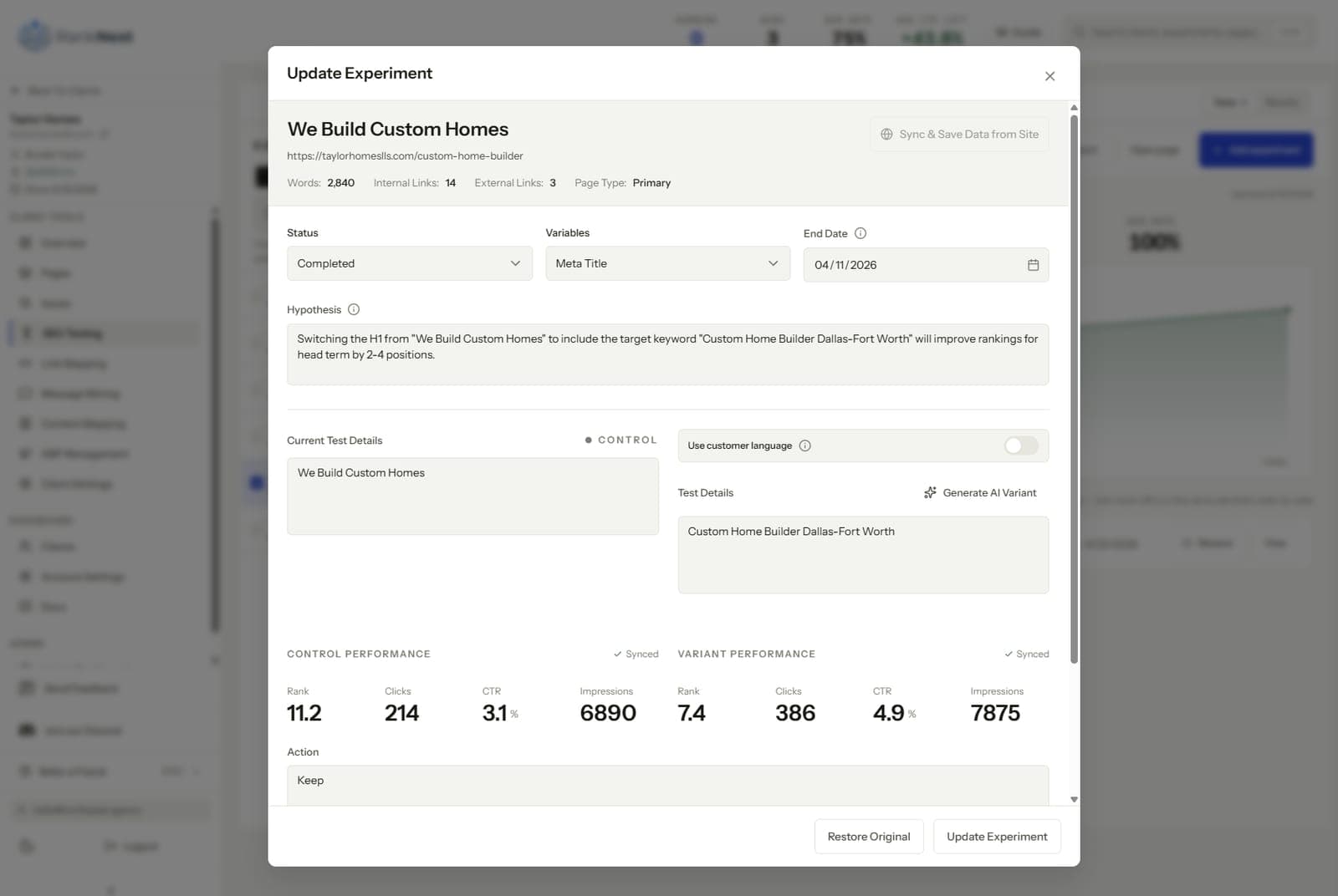
The alternative is to make every meaningful change on the account an experiment. Snapshot the page's GSC performance, ship the change, record the date, compare matched windows afterward. The mechanics are covered in our complete guide to SEO testing for agencies, and they work on small local sites as well as big ones, so client size is no excuse.
What this produces over a quarter is a stack of small, dated, defensible claims.
- March 4, rewrote the title on /water-heater-repair, CTR rose from 1.8 to 3.1 percent over 6 weeks, about 45 extra clicks a month.
- March 18, added 4 internal links to the commercial services page, average position moved from 9.2 to 6.8.
- April 2, tested a new meta description on the pricing page, no measurable change, reverted.
Notice the third line. Reporting a null result is part of the proof, because a log with no losses reads as marketing. The client learns that when you claim a win, the claim went through the same filter that catches the losses.
Tooling matters here only because manual baselining is the step that dies under deadline pressure. This loop is what RankNest's experiment tracking automates, the baseline snapshots itself when a test opens, and the delta reports itself when the window closes. A disciplined spreadsheet works too, as long as baselines are captured before changes ship, and our roundup of SEO testing tools compares the options honestly by segment.
Translate deltas into the client's revenue math
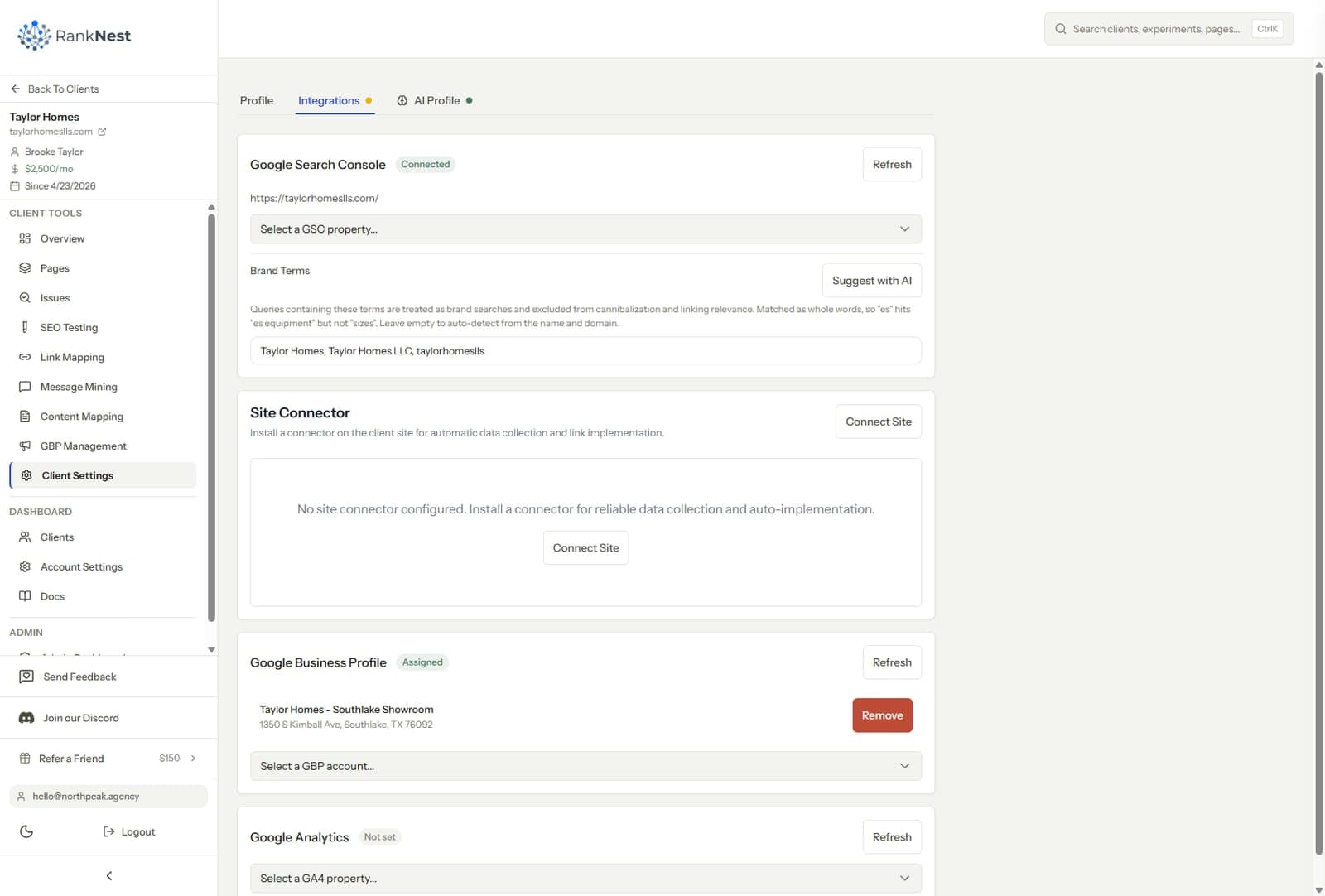
Clicks are your unit, never the client's. The conversion into money takes one conversation at onboarding and about 3 questions. What is a lead worth, what share of leads close, what is an average job or order worth.
Store those answers where the account team can see them, we keep revenue context pinned to each client workspace for exactly this reason. Then every test result converts on contact.
Take the title test above. Forty-five extra clicks a month, the client's site converts visitors to leads at 4 percent, they close 1 in 4 leads, average job $2,800. That is roughly 1 to 2 extra jobs a quarter, worth around $4,200, from one afternoon of work. Said that way, the change explains a meaningful slice of the retainer by itself.
Keep the arithmetic conservative and show it openly. Round down, use the client's own numbers, and label estimates as estimates. A conservative number the client can audit beats an impressive number they suspect.
The retention math of proof
Testing takes effort, so it competes with delivery work. Here is the math that settles the argument, using round numbers you can swap for your own.
A $2,000-per-month client who churns at month 8 instead of month 24 costs you $32,000 in lost revenue, before you count the sales cost of replacing them. The testing overhead that builds a causal evidence log, maybe 3 or 4 hours per client per month, costs a fraction of that at any billing rate. If evidence extends the average engagement by even a few months across a 10-client roster, it outperforms nearly anything else those hours could produce.
Churn also compounds in reverse. Clients who see per-change proof refer other owners, expand scope, and forgive bad months, because the log shows the work continuing while the market wobbles. The agencies that scale past the referral plateau are usually the ones that made their value legible, and that legibility is a system you build once and run everywhere, as we lay out in our multi-client SEO operations playbook.
What to say to clients, three scripts
Evidence only retains clients if it reaches them in words they use. Three conversations come up constantly, here is language that works.
The skeptical prospect, "how will we know it's working?"
"Every meaningful change we make gets logged with a before-and-after measurement from your Search Console data. Each month you will see what we changed, what happened, and what it is worth in leads. Some changes will not work, you will see those too, along with the revert."
The month-6 wobble, "we're not sure we're seeing value."
"Fair question, let us look at the change log rather than the traffic graph. This quarter we shipped 9 measured changes, 6 moved their metric, here is what those 6 add up to in leads at your close rate. If the concern is a specific number, tell me which one and I will show you what is driving it."
The algorithm update panic, "traffic just dropped, what are we paying for?"
"The drop hit on the 14th, matching a confirmed Google update, and it hit sites across your industry. Here is our change log for the period, nothing we shipped correlates with the drop, and here are the two tested wins still holding above baseline. Our plan for the next 30 days is on one page, here it is."
None of these scripts work without the log behind them. All of them fail as bluffs.
Set the evidence system up at onboarding
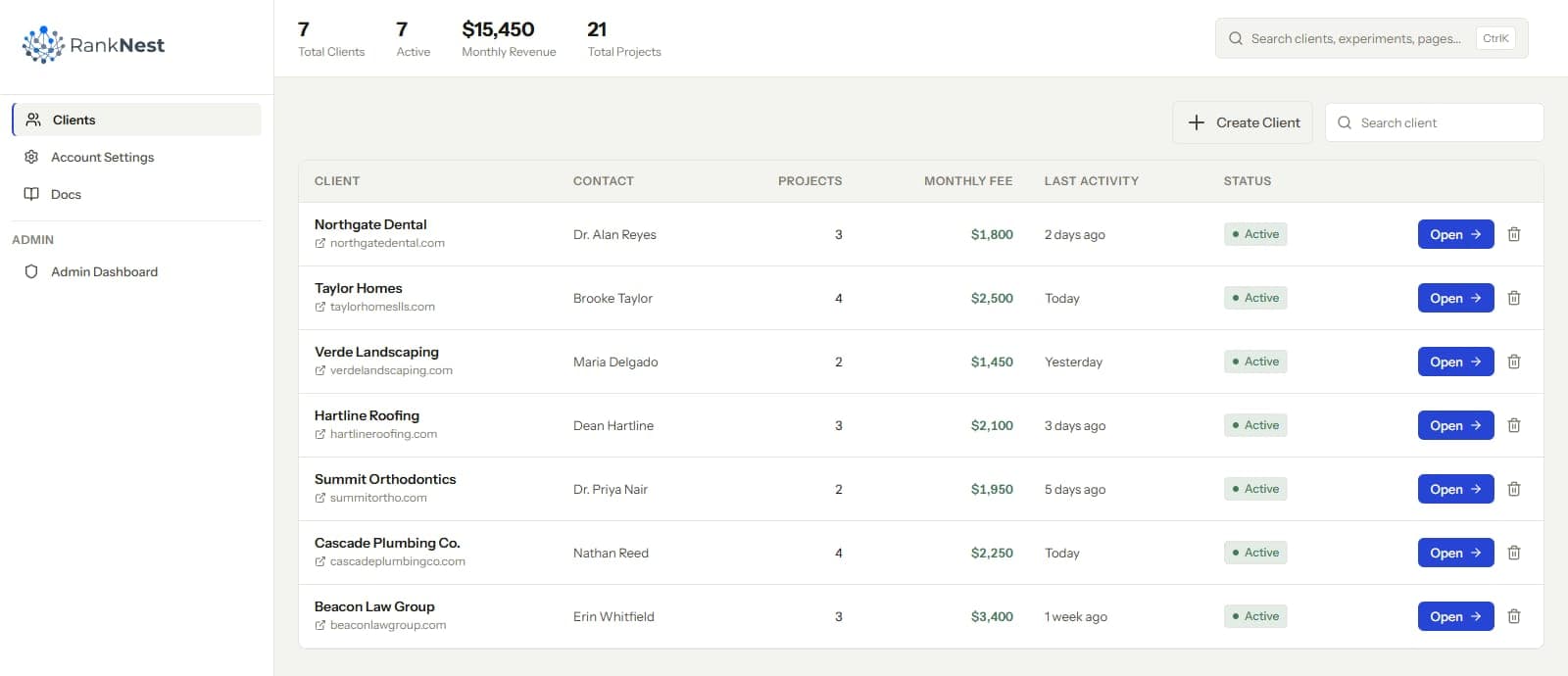
Proof is much easier to produce when the engagement starts with it. Four things belong in the first two weeks of every new account.
First, collect the revenue math before you touch the site. Lead value, close rate, average job value, straight from the owner's mouth, recorded where the account team works. Clients answer these questions happily in week one and suspiciously in month 8.
Second, get standing written approval for on-page changes below an agreed scope. Testing dies when every title tag needs a signature. Logged and reversible is the promise that makes clients comfortable signing that.
Third, set the expectation that some tests will fail, out loud, before any test runs. A client warned that some changes move nothing will read your null results as rigor. A client promised only wins will read them as failure.
Fourth, ship a measurable change in the first 14 days and open its baseline the same day. The first renewal conversation is easier when the evidence log is as old as the invoice history.
Anti-patterns that undo the proof
- Reporting rankings for keywords nobody searches. Position 1 on a zero-volume query converts to zero dollars, and clients eventually notice.
- Claiming credit for site-wide tides. If everything rose, including pages you never touched, say so, the honesty pays out later.
- Hiding losers. One discovered omission costs more trust than 10 reported nulls.
- Sending the dashboard as the report. A dashboard is an appendix. The report is the narrative of changes, effects, and next steps.
- Promising causation you did not measure. Retroactive stories about why traffic moved are exactly what testing exists to replace.
FAQ
How do you show SEO ROI to a client?
Log every meaningful change as a dated experiment, measure it against a GSC baseline, then convert the click deltas into leads and revenue using the client's own close rate and job value. Present it as a change log, what we changed, what happened, what it is worth. This shows causation, which a traffic dashboard cannot.
What is a good ROI for SEO?
There is no universal benchmark, because it depends on the client's margins, lead value, and starting position. The practical standard is that measured wins should visibly exceed the retainer within the first 6 to 12 months, calculated conservatively with the client's own numbers. Agencies get in trouble quoting industry ROI figures they cannot reproduce.
How long before SEO shows measurable results?
Individual experiments read out in 4 to 12 weeks, which is the honest answer to give instead of the vague 6-months line. CTR and title tests show movement fastest, content and technical work takes longer. Framing the engagement as a stream of measured tests gives clients visible progress long before topline traffic transforms.
Why do clients cancel SEO retainers?
Usually because they cannot connect the invoice to an outcome, and the monthly report never made the connection for them. Ranking screenshots and traffic graphs show activity and correlation, so trust erodes the first slow month. Per-change evidence with revenue math attached is the strongest known fix.
Can you prove SEO caused a revenue increase?
You can get close for specific changes, a dated change, a measured lift against baseline while the rest of the site stayed flat, converted through the client's own funnel numbers. Site-wide, attribution stays fuzzy and you should say so. Clients trust an agency that claims precise credit for specific changes and honest uncertainty everywhere else.