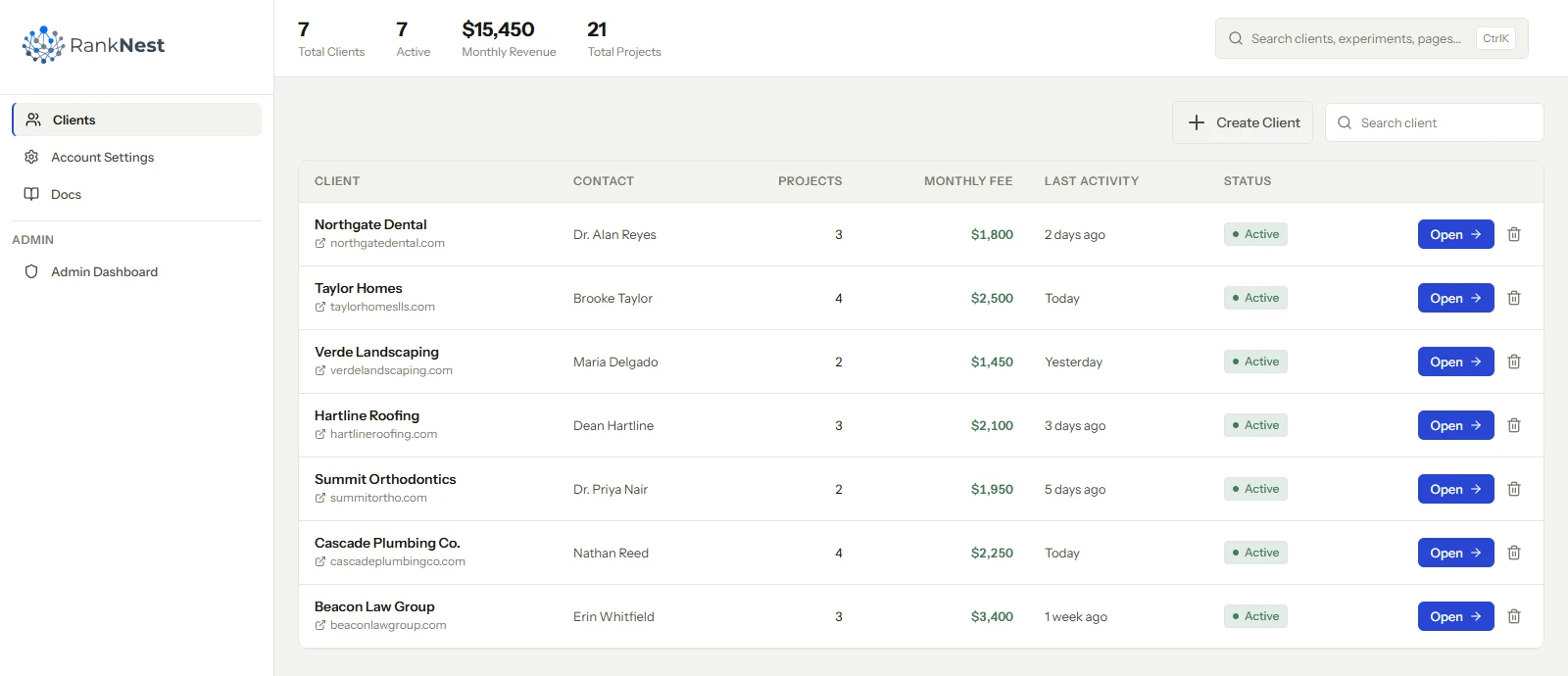

Scaling SEO for multiple clients means replacing ad-hoc, per-client work with a standardized delivery system. Strategy stays custom for each client. The process that delivers it becomes identical everywhere.
Four pieces make that possible.
- Documented SOPs for onboarding, audits, and monthly delivery
- Fixed cadences for auditing, internal linking, testing, and reporting
- Capacity planning that ties delivery hours to retainer size
- One consolidated toolset instead of a per-client pile
This playbook walks through each piece in the order you should build it, with the planning numbers we use ourselves.
Why per-client SEO breaks after five clients
Almost every agency starts the same way. The founder personally runs SEO for the first few clients, holds every detail in memory, and quality is genuinely high. That approach works up to about 4 or 5 clients.
Past that point, context switching starts eating the calendar. Every audit gets rebuilt from a blank spreadsheet. Internal linking happens whenever someone remembers it. Reporting week swallows the last five business days of every month.
The first thing to collapse is margin, and it collapses quietly. Hours per client creep up while retainers stay flat, so you feel busier every month at the same revenue. Quality goes next, because the founder's attention is now a rationed resource.
I hit this wall at Grindstone Design, the agency I still run. Client six was the one that exposed it. Nothing about the work got harder, there was simply more of it than one head could hold.

What a standardized SEO delivery system is
A standardized delivery system is a fixed set of workflows that every client moves through on a known schedule, regardless of niche or size. The strategic decisions inside those workflows change per client. The workflows themselves never do.
In practice that means five repeating motions.
- An onboarding SOP that runs from contract to first shipped win in a fixed window
- A technical audit cadence, full crawl quarterly, delta check monthly
- A monthly internal linking deliverable
- A testing cadence that measures the changes you ship
- A reporting cadence assembled from the four motions above
The rest of this playbook takes them one at a time.
Step 1: Standardize onboarding
Onboarding sets the ceiling for everything after it. If access collection drags for three weeks, your first report has nothing in it and the retainer starts on the back foot.
Run onboarding as a day-by-day SOP with a fixed deadline. We use 14 days from signed contract to first shipped win. The sequence never varies. Collect access, snapshot the baseline, run the technical and link audits, ship quick wins, send the first report. For the full day-by-day version, see our SEO client onboarding SOP.
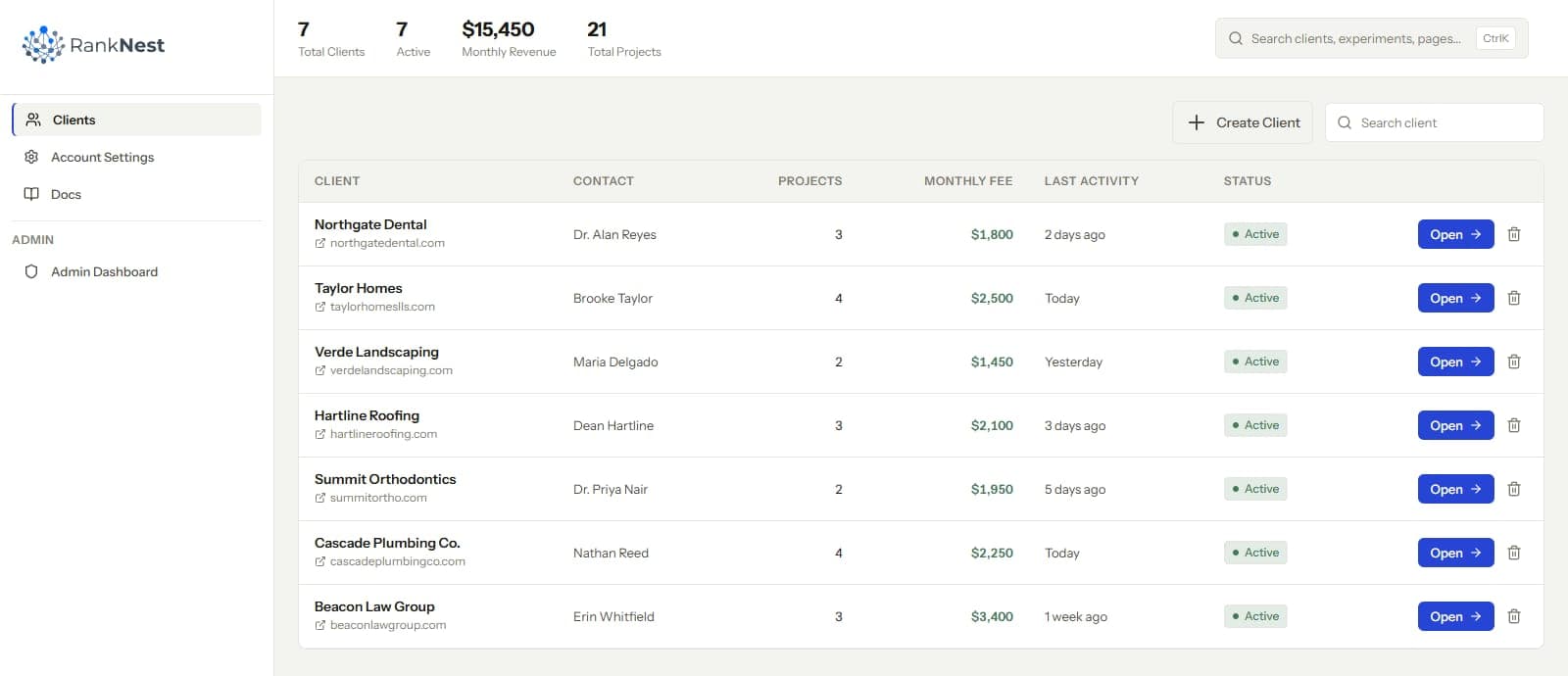
Set up a home for each client on day one. A dedicated workspace per client, pinned to the correct GSC property and GBP location, kills the wrong-property class of error before it exists. It also gives every future audit, link batch, and test a place to live.
Record revenue context during onboarding too. When you know a booked job is worth $4,000 to one client and $90 to another, prioritization decisions for the next year get easier.

Step 2: Put audits on a fixed cadence
Ad-hoc audits are the biggest hidden time sink in multi-client work. Someone notices a problem, opens a crawler, and loses a day rebuilding an analysis that has no template. The fix is a two-tier cadence, a full technical crawl every quarter and a light delta check every month. If you want the full operating model, see how to run SEO audits across an entire client portfolio.
The full crawl covers status codes, indexability, meta tags, redirect chains, response times, and schema. Running it through an automated technical audit turns a day of manual crawling into a scheduled job you review in 20 minutes per client.
The monthly delta answers a single question, what changed since last month. New 404s, dropped pages, fresh redirect chains, broken schema. It takes minutes per client and catches problems while they are still cheap to fix.
Twice a year, pair the crawl with a deeper pass over internal links. Our walkthrough on auditing a site's internal link structure covers that checklist in full, click depth, orphaned pages, anchor distribution, and dead ends.

Step 3: Make internal linking a monthly deliverable
Internal linking is the highest-leverage recurring deliverable in most retainers. It needs no ad budget, no dev queue, and no client approval cycle. It is also the first thing agencies drop when they get busy, because nobody on the client side asks about it.
Fix that by making it a named line item, one batch of internal links per client per month. Pick a priority page, find the related content that should point at it, add links with descriptive anchors, log the batch with a date. The log matters later, when you want to connect the batch to a movement in position.
Two resources are worth building your process on. Our complete guide to internal linking strategy covers target selection and anchor choices. And fixing orphan pages across a client portfolio is usually the best first batch, since orphans are cheap to find and cheap to repair.
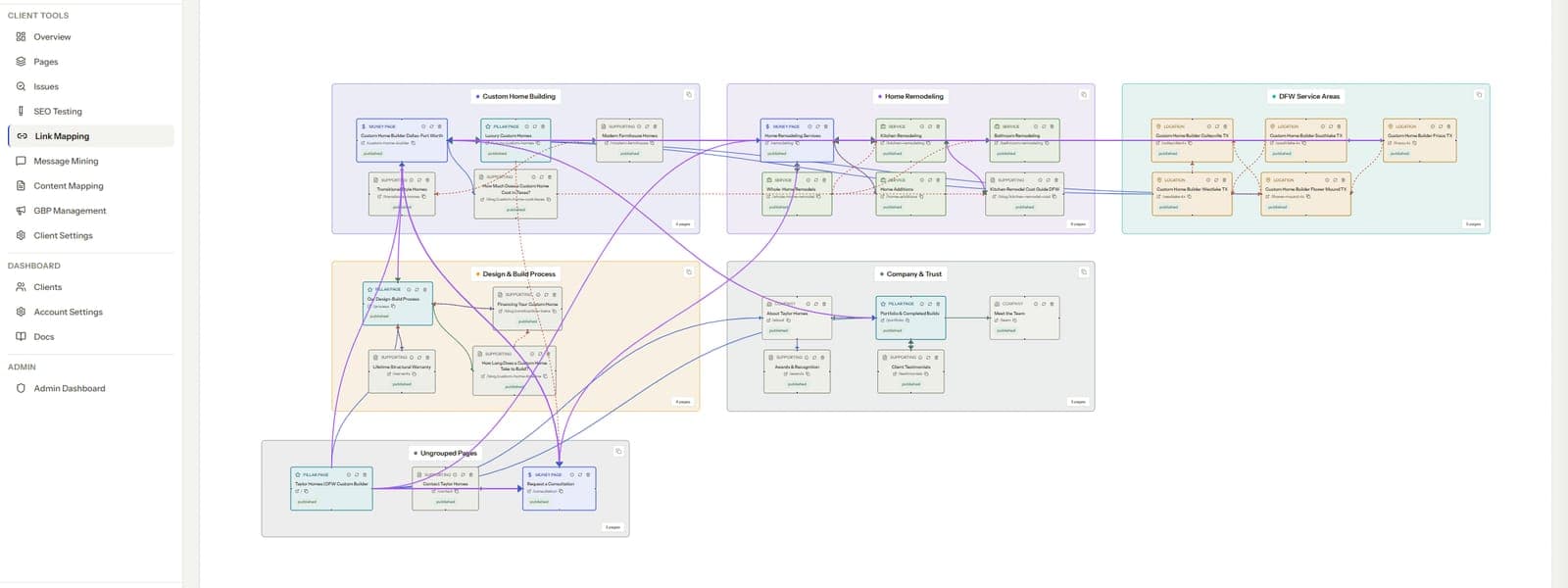
Spreadsheets stop working for this at portfolio scale. A visual map of each client's link graph shows hubs, orphans, and dead ends at a glance, and can generate a prioritized list of links to build next. That turns the monthly batch into an hour of review instead of an afternoon of tab-hopping.

Step 4: Test the changes you ship
Most agencies ship changes and hope. At one client that is survivable. Across ten clients it means you cannot tell which parts of your own process actually work.
The practical method for client sites is time-based before and after testing. Sync a GSC baseline before the change, ship the change, then read the delta over the following weeks. Setting this up as a tracked SEO experiment gives every meaningful change a before and after record you can show a client.
You do not need to test everything. Test the changes you repeat across clients, title rewrites, internal link batches, schema additions, content refreshes. When a pattern wins on three or four sites, promote it into the SOP for every client. That is how an agency compounds knowledge instead of re-learning it per account. If you want the client-facing version of this, our guide to how to prove SEO ROI to clients with experiments, not dashboards shows how to turn those test results into causation and revenue.

Step 5: Make reporting an output, not a project
If reporting consumes a week each month, your team is hand-assembling numbers from tools that do not share data. Under a standardized system the report becomes a byproduct. The audit produced findings, the link batch got logged, the tests produced deltas, and the report collects them. If your reporting stack is still stitched together from exports, our rundown of Raven Tools alternatives for agencies covers the cleaner options.
Use the same structure for every client. What we changed, what happened, what happens next. Clients renew when they can trace fees to changes and changes to outcomes, and that trace is impossible when the report is 30 pages of ranking wallpaper.
The tool consolidation math
Multi-client stacks grow one purchase at a time. A crawler here, a rank tracker there, a reporting dashboard, an internal linking plugin on each WordPress site, maybe a testing tool. Each purchase made sense on its own.
Now price the whole pile. Say you run five single-purpose tools at $40 to $150 each. That is $200 to $750 a month before anyone does client work, plus five logins, five exports, and five places for the numbers to disagree.
Consolidation is why we built RankNest the way we did. Audits, link maps, testing, client workspaces, and GBP post scheduling sit in one platform, every feature ships on every tier, and pricing runs $50 to $500 a month based only on client count.
Whatever platform you choose, apply one test. Count the tools you touch to produce a single monthly client report. If the answer is more than two or three, you have found where your margin went.
Capacity planning: hours per client per month
Scaling breaks fastest when you sell retainers without knowing what they cost in hours. These are the planning bands we use. Treat them as starting points and correct them with your own time tracking.
| Monthly retainer | Delivery hours | What fits in scope |
|---|---|---|
| $500 to $1,000 | 5 to 8 | Quarterly audit, monthly delta, one link batch, GBP upkeep |
| $1,000 to $2,500 | 10 to 15 | All of the above plus one or two running tests and content briefs |
| $2,500 to $5,000 | 20 to 30 | Full program with content production and a larger testing slate |
Now the other side of the ledger. A full-time SEO has roughly 120 to 130 real delivery hours a month once meetings, admin, and email take their cut. At 10 to 15 hours per client, that is 8 to 12 mid-tier accounts per person, and only if the delivery motions are standardized.
If your actual hours run above these bands, treat it as a process problem before a pricing problem. Cadences and automation usually close most of the gap. Raise prices after you have fixed delivery, and the raise sticks.
Packaging retainers around the system
Once the delivery motions are fixed, retainer packaging almost writes itself. Each tier is a bundle of motions at a frequency, and scope conversations become concrete. A client asking for more content is asking to move up a tier, with a known hour cost and a known price.
Set a retainer floor and hold it. Below roughly $500 a month there is no version of the cadence that fits the hours, so the account loses money or gets neglected. Either outcome damages the agency more than the declined revenue would have helped.
Packaging by motion also contains scope creep, the quiet margin killer. When a client asks for something outside the bundle, the answer is a calm one, that fits in the next tier, here is the price. Agencies without defined motions end up doing tier-three work at tier-one prices and calling it relationship building.
The weekly operating calendar
Here is what the system looks like as an actual week, for a two-person team running 10 clients on standardized cadences.
- Monday morning, run delta checks across all 10 clients, about 3 hours total
- Monday afternoon, triage anything the deltas surfaced
- Tuesday, this week's quarterly audit, one client per week on rotation
- Wednesday, internal linking batches for the week's scheduled clients
- Thursday, testing reviews, read deltas on running experiments, launch the next ones
- Friday, client calls, plus report assembly during the last week of the month
Notice that every client touches the calendar every week, and no client dominates it. Compare that against the ad-hoc alternative, where whichever client complained most recently gets the week. A calendar owned by cadences serves ten clients evenly, a calendar owned by urgency serves one client at a time, badly.
Templatizing without going cookie-cutter
Agencies resist standardization because they assume it means giving every client the same strategy. Done right, it means the opposite. You templatize the container and the calendar, then customize what goes inside.
The audit cadence is identical for a plumber and an ecommerce store. What you do with the findings differs completely. The plumber's quick wins live in GBP and service pages, the store's live in category structure and faceted navigation.
A useful sorting rule, if a task's steps stay the same regardless of the client's business, it belongs in an SOP. If the steps depend on the client's market, it stays judgment work. Standardize the first group ruthlessly and protect calendar time for the second.

When to hire and when to automate
Automate the machine work first. Crawls, delta checks, link suggestions, report assembly, GBP post scheduling. This work is high volume and low judgment, and software does it without drift or sick days.
Hire when judgment work exceeds founder capacity. The signals are consistent across agencies. Strategy calls get rescheduled, QA passes get skipped, and the sales pipeline goes quiet because delivery ate the week.
For most shops the first delivery hire lands somewhere between 8 and 12 clients, later if automation carries the machine work. Write the SOPs before the hire. A new person walking into documented cadences multiplies capacity, a new person walking into improvisation multiplies chaos.
How to roll this out in 30 days
You can move an existing book of clients onto a standardized system in about a month without pausing delivery.
- Week 1, write down what you actually do today for each client, gaps included
- Week 2, define the cadences and deliverable formats, then map every client onto the calendar
- Week 3, consolidate tools and connect every client's GSC and GBP in one place
- Week 4, snapshot a baseline for every client so all future work has a before
The baseline step is the one agencies skip and regret. Every result you ever want to claim depends on having a before to point at.
Does this scale down to freelancers and sideways to in-house teams?
Yes, and mostly unchanged. A solo freelancer running 5 or 6 clients needs the cadences more than an agency does, because there is no colleague to catch a dropped ball. The only real adjustment is capacity math, a freelancer who also does sales and admin has closer to 90 delivery hours a month than 120.
Freelancers also gain the most from the baseline habit. When you are the whole company, documented before-and-after evidence is your renewal pitch, your case study, and your referral engine in one artifact.
In-house SEOs managing multiple sites or locations run the same playbook with one substitution. The client is a stakeholder, the retainer is a headcount justification, and the reporting cadence defends the budget line the same way it defends a retainer. Multi-location businesses get one extra motion, keeping GBP profiles active per location on a schedule rather than in bursts. That report needs to read like SEO client reporting that proves causation, not correlation, so each site change can be tied to a dated outcome.
Mistakes that stall agencies at ten clients
- Selling a custom reporting format to every client, which turns month end into ten bespoke projects
- Letting cadences slip for urgent requests, the request goes into the schedule, the cadence stays fixed
- Running with no retainer floor, since one $400 client can consume the hours of a $2,000 one
- Skipping baselines when work starts, which makes every later result unattributable
- Installing a separate plugin stack on each client site, multiplying logins, updates, and billing
- Measuring the team on tasks closed rather than outcomes shipped per client
None of these feel like mistakes in the moment. Each one is a small accommodation that compounds across the portfolio until the calendar has no slack left.
FAQ
How many SEO clients can one person manage?
With standardized delivery and automation handling crawls and reporting, one full-time SEO can run 8 to 12 mid-tier retainers. Without systems, most people cap out near 5. High-touch or enterprise accounts cut those numbers sharply.
What should an SEO agency workflow include?
A repeatable workflow covers onboarding, a technical audit cadence, a monthly internal linking deliverable, testing of shipped changes, and standardized reporting. Every client moves through the same motions on the same calendar. The strategy inside each motion stays specific to the client.
What should a monthly SEO retainer include?
At minimum, a delta audit, one internal linking batch, visible progress on the quarter's priorities, and a report structured as changes made, results measured, next steps. Larger retainers add content production and a running testing program.
How do you standardize SEO without giving every client the same strategy?
Standardize the process, the calendar, and the deliverable formats, then customize targets and priorities per client. The audit checklist is identical everywhere. What you fix first depends entirely on the client's business model and revenue drivers.
When should an SEO agency make its first delivery hire?
Hire when judgment work, meaning strategy, QA, and client communication, exceeds founder hours even after automating crawls and reporting. That point usually arrives between 8 and 12 clients. Document your SOPs first so the new hire walks into a system.
How much should an agency spend on SEO tools?
Judge the stack by tools touched per client report rather than by total spend. A pile of five single-purpose tools can run $200 to $750 a month and still force manual assembly at month end. A consolidated platform priced by client count keeps tool cost proportional to the revenue it supports.