The best SEO testing tools in 2026 are RankNest and SEOTesting.com for agencies and small sites, SearchPilot and seoClarity for enterprise split testing, and Statsig for engineering-led teams. An SEO testing tool measures whether a specific change improved organic performance. It does that either by splitting similar pages into control and variant groups, or by comparing before and after against a Search Console baseline. If you are working with a small site, our guide to how to run SEO tests on small sites covers the before-and-after method in detail.
Search this keyword and you will mostly find lists of free site checkers. Those audit a page against best practices, which is a different job. This post covers actual experimentation tools, the kind that tell you whether the title tag rewrite you shipped in March moved clicks.
For agencies the stakes are specific. A test result is the difference between a monthly report that says "rankings fluctuated" and one that says "here is the change we made and here is what it earned." Clients renew for the second sentence. If you want the client-side version of that argument, our guide on how to prove SEO ROI to clients with experiments, not dashboards walks through the math and the scripts.
We build RankNest, one of the six tools compared here. We will make our case where it applies and point you elsewhere where it does not.
Checkers vs experimentation platforms
Two intents share this keyword, so thirty seconds on the difference.
An SEO checker grades a page against a rulebook. Missing meta description, slow response, thin content. Useful for audits, silent on outcomes.
An SEO testing tool measures outcomes. You change something, it tracks what happened against a baseline or control group, and you find out whether the change earned its place. Everything below is in this second category.

Split testing vs before-and-after testing
The tools in this roundup use one of two methodologies, and the split matters more than any feature.
Split testing divides a large group of similar pages, product pages or listings, into control and variant buckets, then compares their aggregate performance. It is statistically strong and it requires scale, generally 1,000 or more similar pages with steady traffic. That describes ecommerce catalogs and marketplaces, and almost no agency client.
Before-and-after testing takes a Search Console baseline for a page or page group, ships the change, and measures the delta over a defined window. It works on a 200-page local business site, and it demands honesty about confounds like seasonality and algorithm updates. Our complete guide to SEO testing for agencies covers how to run that methodology without fooling yourself.
Comparison table
| Tool | Methodology | Minimum viable site | Built for | Starting price |
|---|---|---|---|---|
| RankNest | Before-and-after vs GSC baseline | Small sites work | Agencies, multi-client SEOs | $50/mo |
| SEOTesting.com | GSC time series and split tests | Small sites work | SMBs, solo SEOs, agencies | $50/mo |
| SearchPilot | Server-side split testing | 1,000+ page sections | Enterprise in-house teams | Not public |
| Semrush Enterprise (SplitSignal) | Split testing | Large templated sites | Enterprise Semrush customers | Not public |
| seoClarity Split Tester | Split testing | Large templated sites | Enterprise | Not public |
| Statsig | General experimentation platform | Depends on implementation | Product and engineering teams | Not verified |
Pricing was checked against public pricing pages in July 2026. Half of this market sells on a demo call, which tells you who those tools are for.
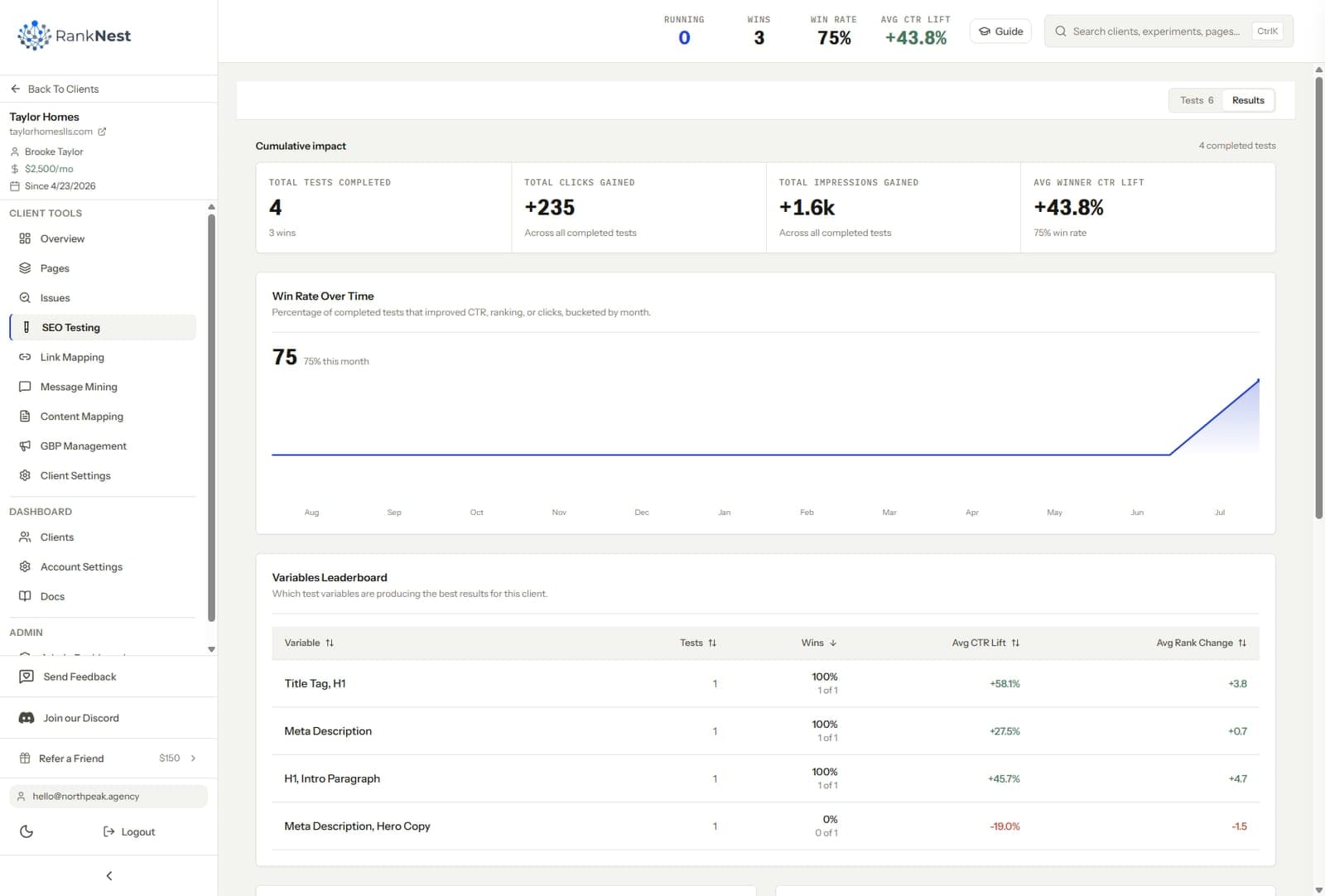
1. RankNest, best for agencies testing on client sites
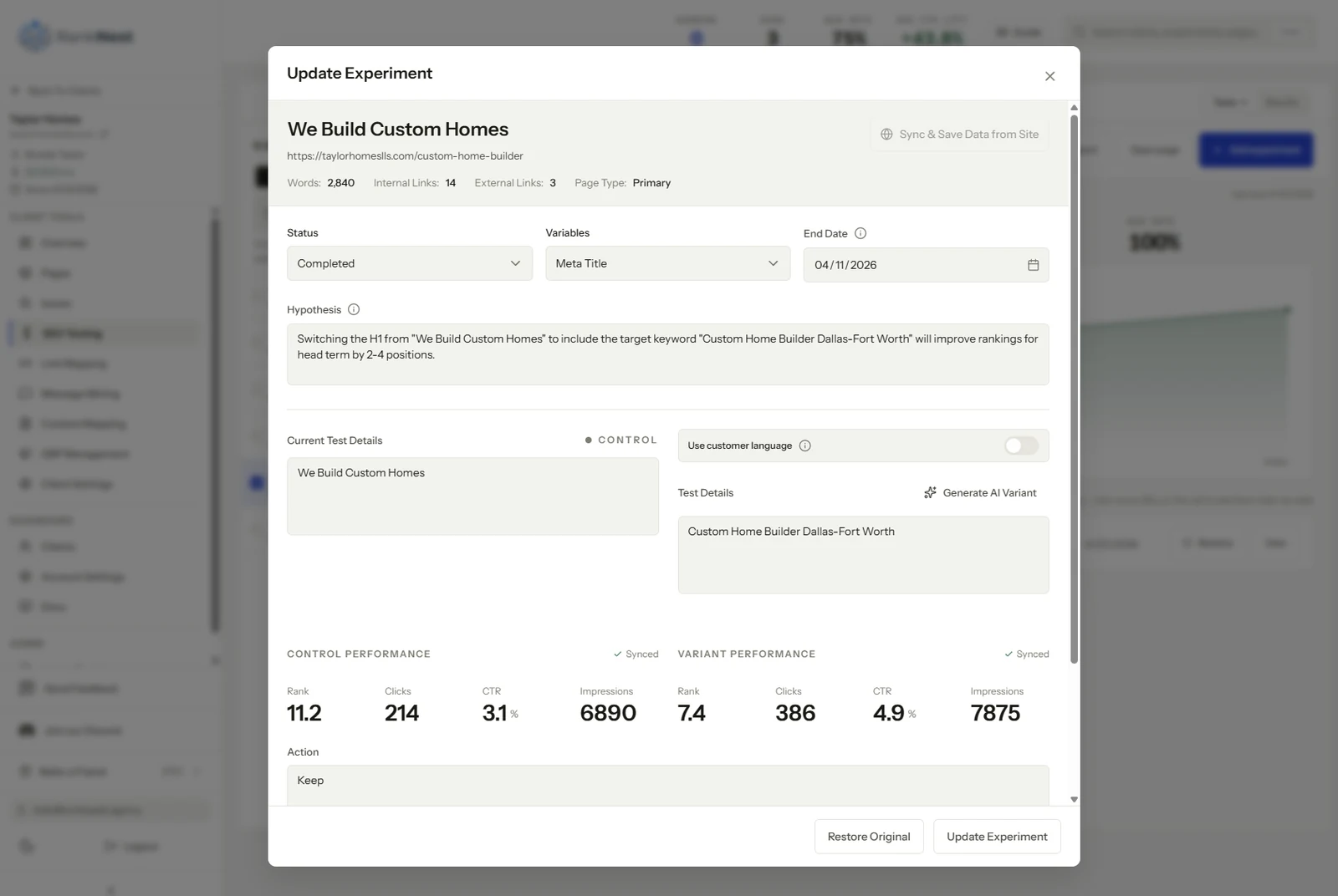
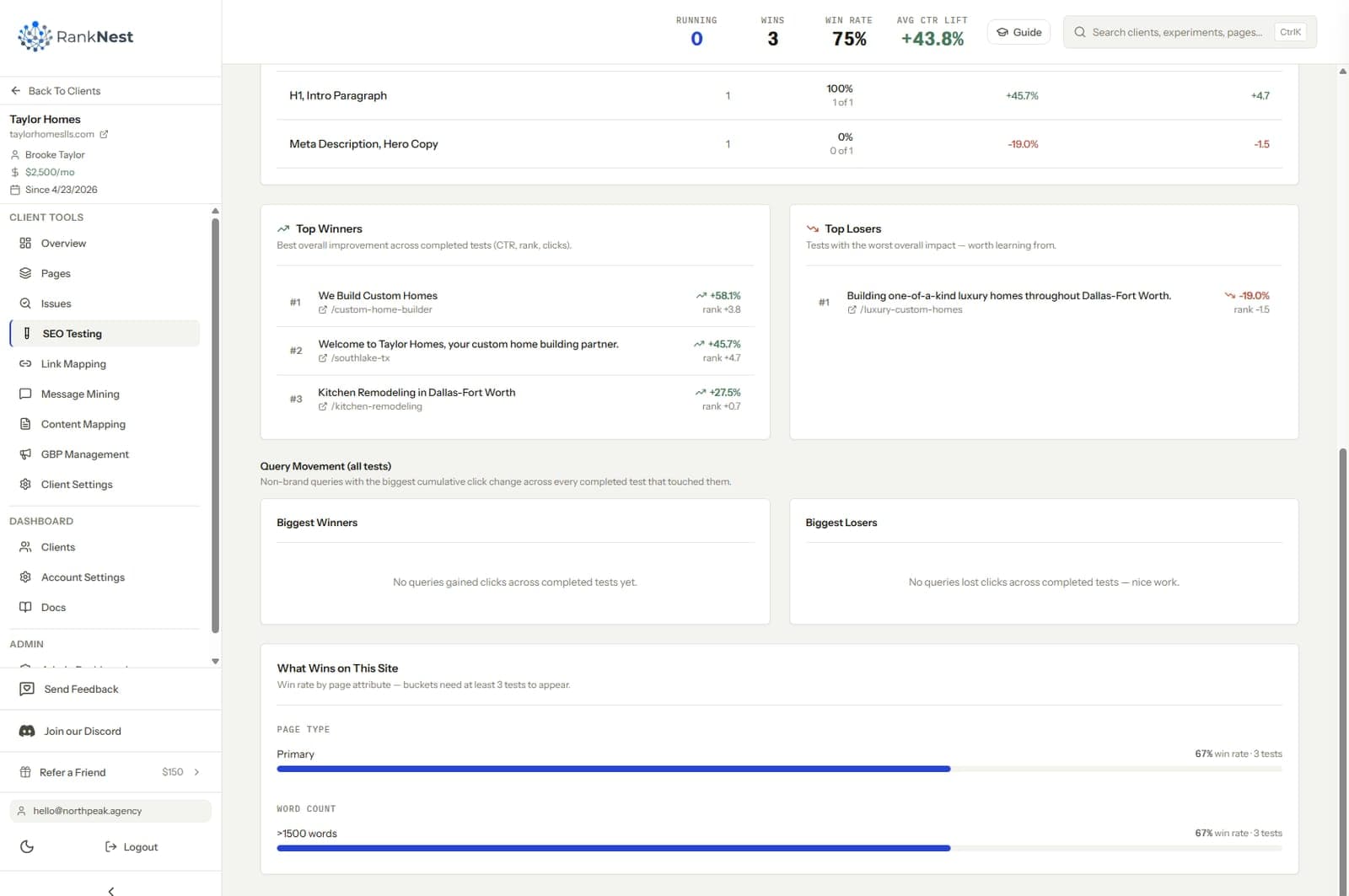
RankNest treats SEO testing as one step in a client workflow rather than a standalone product. You set up an experiment, sync the Search Console baseline, push the change, and read the before-and-after delta inside the same workspace that holds that client's link map, site audit, and reporting context.
That workspace part is the honest differentiator. Testing tools produce results, and agencies still have to turn results into a retainer-defending story per client. Having the experiment, the linking plan that motivated it, and the client's revenue context in one place removes the copy-paste layer, and the before-and-after methodology means a 300-page plumber site is big enough to test.
Honest limits. There is no server-side split testing, so a marketplace with 50,000 templated pages that wants bucket-level statistical rigor should look at SearchPilot. If you want test ideas to start with, we keep a list of 25 SEO tests that work on client sites.
Pricing runs $50 to $500 per month by client count, and every tier includes testing alongside link mapping, audits, and the rest of the platform.
2. SEOTesting.com, best standalone GSC testing tool
SEOTesting.com is the closest direct competitor to our testing module and a well-built product. It pulls Search Console data into time-series tests, supports page-group split tests, and its reports are clean enough to forward to a client. For a solo SEO or an in-house marketer who wants testing and needs no other workflow, it is the simplest recommendation on this list. If you need more than testing or manage enough sites for the per-site price to add up, compare SEOTesting alternatives.
The trade-off is that testing is all it does. Linking, audits, and client management live in your other tools, and at agency scale the per-site pricing model starts to add up.
Verified July 2026, plans run $50 per month for one site, $125 for five, and $375 for twenty, with a 14-day trial and no credit card required.
3. SearchPilot, best for enterprise split testing
SearchPilot grew out of Distilled's ODN platform and is the reference name in serious SEO split testing. It serves variant pages server-side, runs proper control groups, and has published years of test results that the whole industry reads. For an enterprise site with the traffic to feed it, it is the rigorous choice.
The entry bar is the point. The methodology needs sections of 1,000 or more similar pages, and the product targets enterprise in-house teams with sales-led onboarding. Pricing is not public. Most agencies will only touch SearchPilot through one very large client, if at all.
4. SplitSignal, now Semrush Enterprise
SplitSignal was Semrush's standalone SEO split-testing product, and it has been folded into Semrush Enterprise. The capability still exists for enterprise customers, and the standalone brand is fading, so treat older roundups that list it separately as dated.
If your organization is already on Semrush Enterprise, ask your account team what testing is included before buying anything separate. Pricing is not public and depends on the enterprise agreement.
5. seoClarity, best for testing inside an enterprise suite
seoClarity includes an SEO split tester as part of its enterprise platform, alongside rank tracking, content tools, and analytics at very large scale. For companies already paying for the suite, running tests where the rest of the SEO data lives is a real convenience.
Nobody buys seoClarity for testing alone. It is an enterprise platform sold on custom contracts, pricing is not public, and the split-testing methodology carries the same large-site requirements as SearchPilot.
6. Statsig, best for engineering-led teams
Statsig is a general experimentation platform for product teams, with documentation covering SEO use cases. If your company already runs feature flags and product experiments through it, extending that infrastructure to SEO tests can beat buying a separate tool, and you get real statisticians' tooling in the bargain.
The catch is that someone has to build the SEO layer. There are no Search Console baselines or SEO reports out of the box, so this route only makes sense with engineering time attached. It sells on usage-based plans aimed at developers, and we did not verify current pricing for this post.
What a good test needs, whatever tool you buy
The tool matters less than the discipline around it. Four requirements apply to every product on this list.
One change per test. If you rewrote the title tag and added an FAQ block in the same week, you learned nothing attributable.
A synced baseline before the change ships. Pulling historical GSC data after the fact works, and setting the baseline first keeps you honest about what you expected.
A defined window, usually 4 to 8 weeks for before-and-after tests. Deciding the end date in advance stops you from calling the test whenever the chart looks best.
A confound log. Algorithm updates, seasonality, a client quietly editing the page, and GBP changes all contaminate results. Write them down as they happen, because you will never reconstruct them later.
Which SEO testing tool fits your situation
- Agency or freelancer with a client portfolio. RankNest, because tests, link maps, audits, and client workspaces share one login and the methodology works on small sites.
- Solo SEO or in-house marketer, one site, no platform needs. SEOTesting.com, simplest and priced right at $50 per month.
- Enterprise site with 1,000+ page templated sections. SearchPilot, or seoClarity if you already run its suite.
- Semrush Enterprise customer. Ask about the absorbed SplitSignal capability before buying anything else.
- Product org with engineers to spare. Statsig, if you accept building the SEO plumbing yourself.
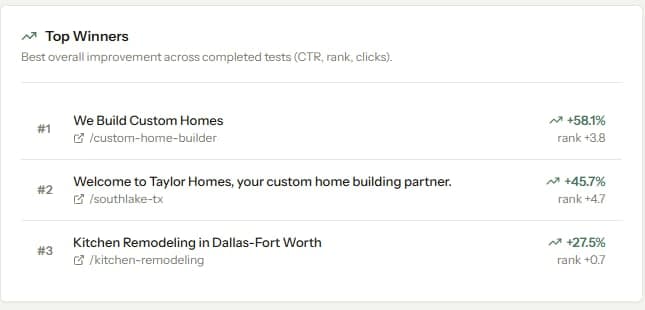
One more note for agencies. Individual tests on small sites carry noise, and the same test repeated across eight clients builds a real evidence base. If FAQ blocks lifted clicks on five of six local service sites, that pattern is worth more than any single result, and it becomes the pitch for running the change on client seven.
Whichever direction you go, run the numbers on what a retained client is worth against what proof costs. A $50 tool that saves one retainer a year pays for itself many times over. You can test that claim against your own client list during the RankNest 14-day free trial, every feature open, no credit card.
FAQ
What is the best SEO A/B testing tool?
SearchPilot is the strongest pure split-testing platform, and it requires enterprise scale, meaning 1,000 or more similar pages per test section. For agencies and smaller sites, RankNest and SEOTesting.com run before-and-after tests against Search Console baselines, which works at any site size.
Can you run SEO tests without 1,000 pages?
Yes, with time-based before-and-after testing instead of split testing. You baseline a page or page group in Search Console, ship one change, and measure the delta over 4 to 8 weeks while noting confounds like seasonality and algorithm updates.
Are free SEO testing tools worth using?
Free checkers are useful for spotting issues, and they do not measure outcomes. The nearest free experimentation setup is Search Console plus a spreadsheet and change annotations, which works and gets tedious past a handful of tests.
What happened to SplitSignal?
Semrush folded SplitSignal into Semrush Enterprise, so it no longer exists as a standalone product you can buy separately. Enterprise customers can ask their account team about split-testing access under their agreement.
How much do SEO testing tools cost?
RankNest and SEOTesting.com both start at $50 per month, verified July 2026. SearchPilot, seoClarity, and Semrush Enterprise sell on custom enterprise contracts without public pricing, and Statsig prices by usage as a developer platform.