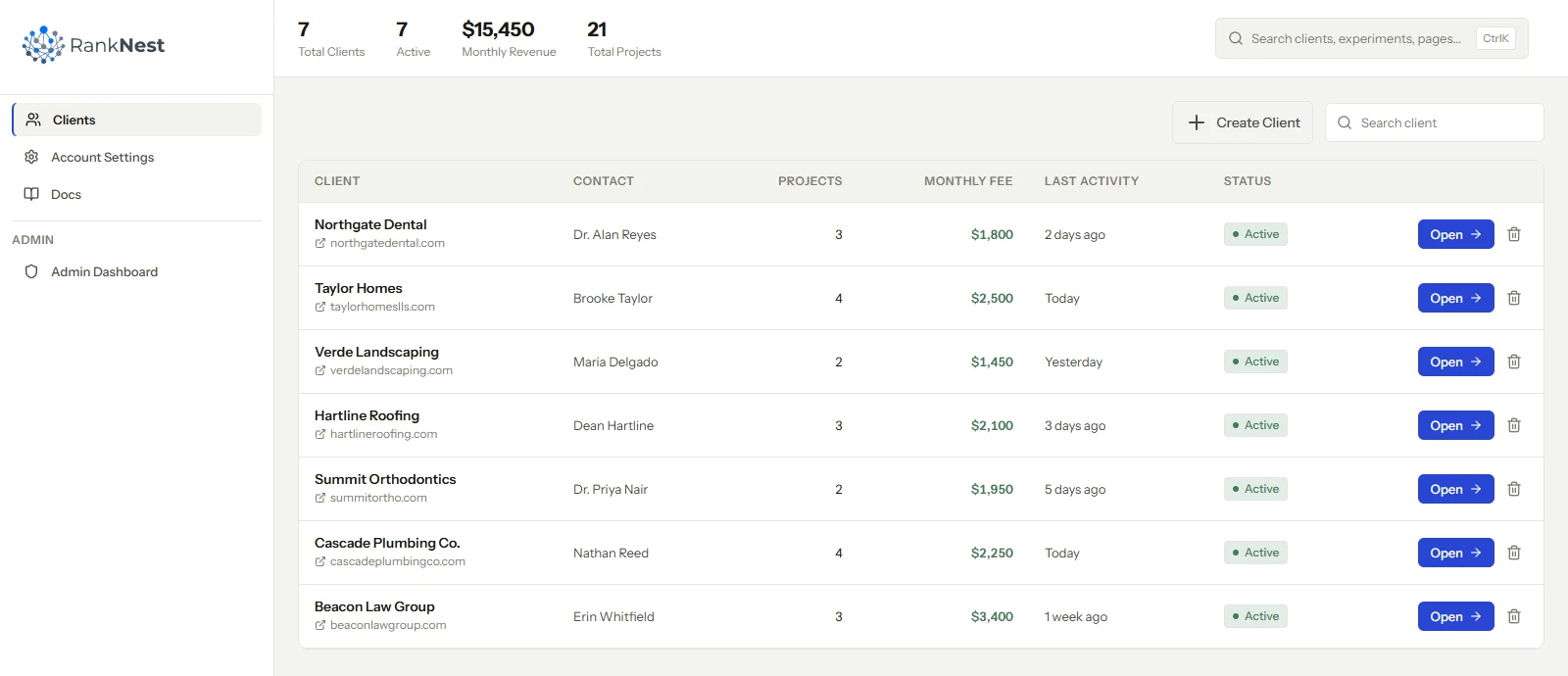

An agency SEO audit process is a recurring system rather than a one-off project. The working model is two-tier, a full technical crawl for each client every quarter and a light delta check every month, run identically across the portfolio on a staggered calendar. Findings drop into a severity-by-effort triage matrix, and the resulting fixes become the backbone of the monthly retainer story. If your audit output still needs a client-facing dashboard, see Raven Tools alternatives for agencies.
Run this way, auditing a 15-client portfolio takes hours per client per quarter. Run as bespoke projects, each audit eats days and half of them never get acted on. This guide covers the cadence, what the crawl should catch, the triage matrix, and how findings feed reporting. For the reporting side, see SEO client reporting that proves causation, not correlation, because the audit only matters when the fixes show up in the monthly story.

Why the one-off audit model breaks at portfolio scale
The classic audit is a big diagnostic project. Someone spends three days crawling, screenshotting, and assembling a 60-page document, the client nods at it, and a third of the recommendations ship. Eighteen months later someone proposes doing it again.
That model fails twice at agency scale. It fails economically, because three days times 15 clients is nine working weeks of audit labor a year. And it fails operationally, because sites break between audits, a migration in March goes unnoticed until the annual crawl in November.
The audit itself was never the deliverable. The fixes are. A recurring cadence with small outputs beats an annual project with a large one, on labor cost and on outcomes.
The cadence slots into the larger delivery system covered in our agency operations playbook for multi-client SEO. Here we go deep on the audit motion alone.
The two-tier cadence: quarterly full, monthly delta
Tier one is the quarterly full audit. A complete technical crawl, a pass over the internal link structure, and a review of anything strategic, content gaps, cannibalization, schema coverage. Budget two to four hours per client once the process is templated.
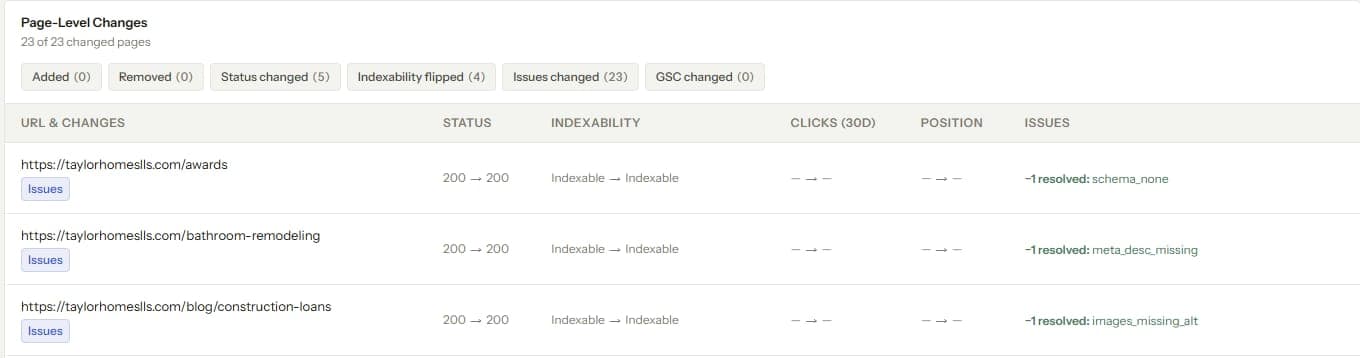
Tier two is the monthly delta check. One question, what changed since the last crawl. New 404s, pages dropped from the index, new redirect chains, broken schema, response time regressions. Fifteen to thirty minutes per client, and it catches breakage within 30 days instead of within a year.
The first full audit for any client happens during onboarding, which our 14-day client onboarding SOP covers day by day. Every quarterly audit after that measures drift from a known state, which is far faster than starting cold.
Stagger the calendar so audits never pile up. With 12 clients on quarterly cycles, one full audit lands per week, so audit work becomes a steady background hum instead of a quarterly crunch.
What a 250 to 500 page crawl actually catches
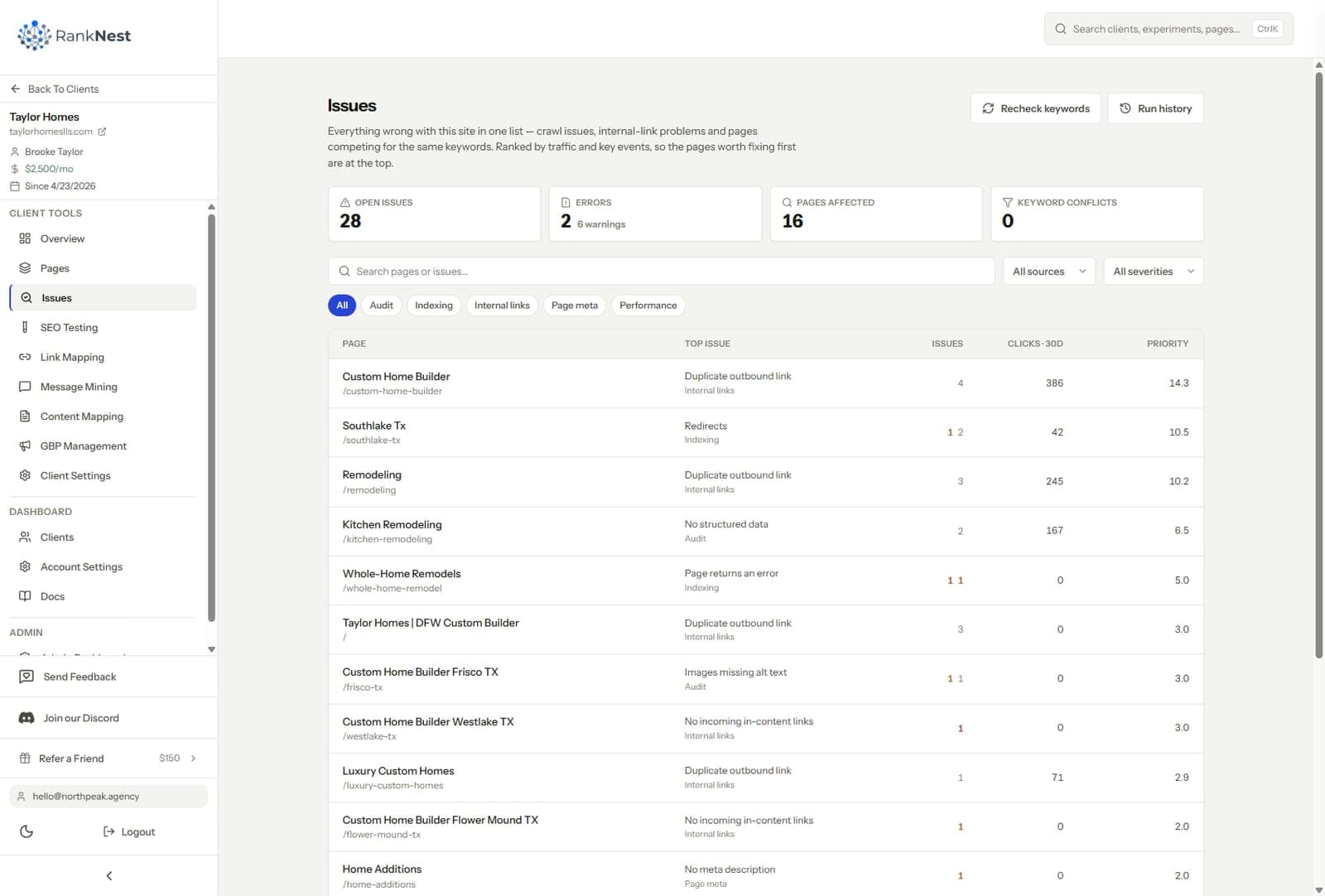
Most agency clients are SMB sites in the 250 to 500 page range, and a full crawl of one surfaces a predictable set of problems. Configure the technical audit to check status codes, indexability, meta tags, redirects, response times, and schema. In RankNest that runs per client workspace, though the checklist matters more than the tool. Expect finds like these.
- Redirect chains left over from a redesign, three or four hops deep
- Service or product pages returning 404 with internal links still pointing at them
- Title tags duplicated across location pages
- Noindex tags that outlived their staging purpose
- Pages responding slowly enough to throttle crawl frequency
- Schema that validated at launch and broke in a template update
Notice that none of these announce themselves. Traffic erodes rather than crashes, which is exactly why the monthly delta exists. On the quarterly pass, pair the technical crawl with a structural one, our guide to auditing internal link structure covers click depth, anchor distribution, and dead ends.
Internal links deserve their own recurring treatment across the portfolio. We wrote up the multi-client version separately, how to audit internal links across 20 client sites without losing a week, and it pairs with this SOP on the quarterly tier.
The monthly delta checklist
The delta check works because it is short and identical every month. This is the whole list.
- New 404s since last crawl, especially pages with internal links pointing at them
- Pages newly dropped from the index, checked against GSC coverage
- New redirect chains or loops
- Schema validation errors that appeared since last month
- Response time regressions on the top 20 pages
- Title or meta changes nobody on your team made
- GSC manual actions or security issues, a 10-second look that must never be skipped
That last item deserves its own sentence. Manual actions are rare, and the one time the check catches one within days instead of months justifies every empty check before it.
The seventh item on the list, unexplained on-page changes, catches a surprisingly common event. Clients edit their own sites without telling their agency, and a delta check is often how you learn a client swapped their service page copy on a Tuesday.
The triage matrix: severity by effort
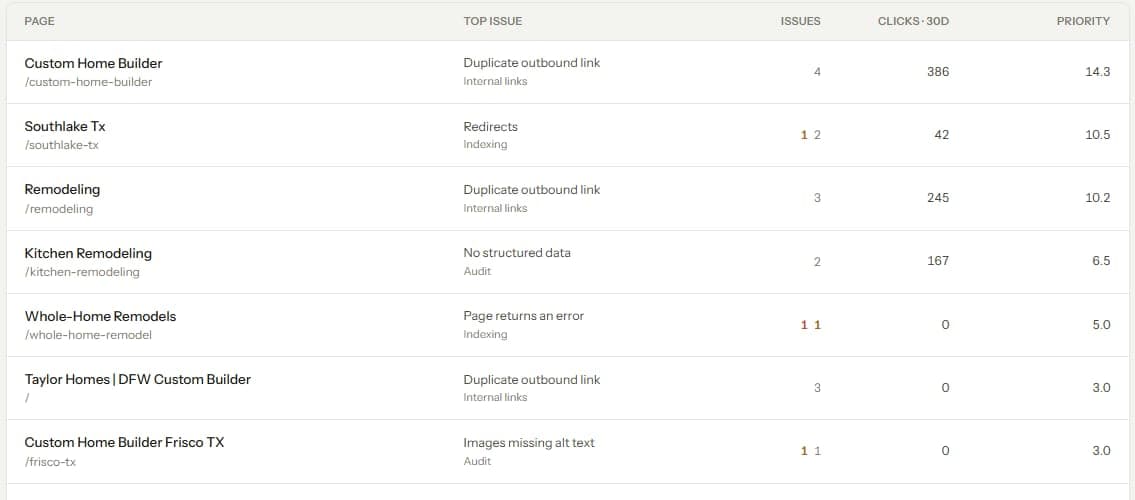
An audit that outputs 200 undifferentiated findings gets ignored. Every finding should land in a two-axis matrix, severity on one axis, effort on the other. That gives four buckets with four different fates.
| Low effort | High effort | |
|---|---|---|
| High severity | Fix this week | Schedule into the retainer roadmap |
| Low severity | Batch into monthly maintenance | Decline, and document why |
High severity means the issue blocks crawling, indexing, or conversion on pages that matter. A noindexed money page is high severity. A missing meta description on a 2014 blog post is not.
The bottom-right bucket is the one agencies mishandle. Some fixes are never worth the hours at the client's retainer size, and writing that down beats letting them haunt every future audit. A declined finding with a reason is a decision. An ignored finding is a liability.
Turning findings into the monthly retainer narrative
Audit findings are raw material for client reporting, and this is where the recurring cadence pays twice. Each month's report has a natural three-part shape, what we changed, what happened, what is next. The audit system feeds two of the three parts automatically.
Fixes shipped from the triage matrix fill the changed section, with dates. The next section comes straight from the top of the remaining matrix. The client sees a system at work, finding problems, ranking them, and clearing them in priority order month after month.
This also reframes what clients think they pay for. A client who sees the delta check catch a broken redirect within 30 days understands the retainer as monitoring plus repair, which is much harder to cancel than a vague monthly optimization fee.
Scheduling the system across the team
A recurring system needs an owner per motion, even in a three-person shop. One person owns the crawl schedule and delta review, findings above a severity line escalate to whoever owns the client relationship. Below the line, they batch into maintenance without a meeting.
Two rules keep the system honest. Every full audit produces a dated triage matrix, no exceptions, and every delta check gets logged even when it finds nothing. Four clean deltas in a row is itself reportable, the site stayed healthy under active monitoring.
Portfolio audit mistakes to avoid
- Running every client's audit in the same week, which guarantees a crunch and shallow triage
- Re-crawling from scratch each quarter with no record of the previous state, so drift stays invisible
- Auditing without acting, a finding older than two quarters is a process failure, either ship it or decline it
- Using a different checklist per client, which quietly rebuilds the bespoke-project model you left
- Treating clean results as wasted effort instead of reportable proof of monitoring
The common thread in all five is the same, the audit system only compounds when its outputs are consistent enough to compare across time and across clients.
FAQ
How often should you run an SEO audit for a client?
Run a full technical audit quarterly and a lightweight delta check monthly. The quarterly pass covers technical health plus internal link structure, while the monthly check catches new breakage within 30 days. Annual one-off audits leave sites unmonitored for months at a time.
How long should an SEO audit take?
With a templated process and an automated crawler, a full quarterly audit of a 250 to 500 page site takes two to four hours including triage. Monthly delta checks take 15 to 30 minutes per client. Multi-day audits are usually a sign the process has no template.
What should a recurring SEO audit include?
The technical pass covers status codes, indexability, meta tags, redirects, response times, and schema. The quarterly version adds internal link structure, click depth to money pages, orphaned pages, and anchor distribution. Every finding gets a severity and effort rating before it reaches the client.
How do you prioritize SEO audit findings?
Score each finding on severity and effort, then work the matrix. High severity and low effort ships this week, high severity and high effort goes on the roadmap, low severity and low effort batches into maintenance. Low severity, high effort findings should be declined in writing rather than left to clutter future audits.
Do small client sites really need quarterly audits?
Yes, because small sites break quietly, a template update kills schema or a redesign leaves redirect chains, and nobody notices in the traffic graph for months. The quarterly audit costs a few hours at most on a 300-page site. The monthly delta makes the interval between full audits safe.