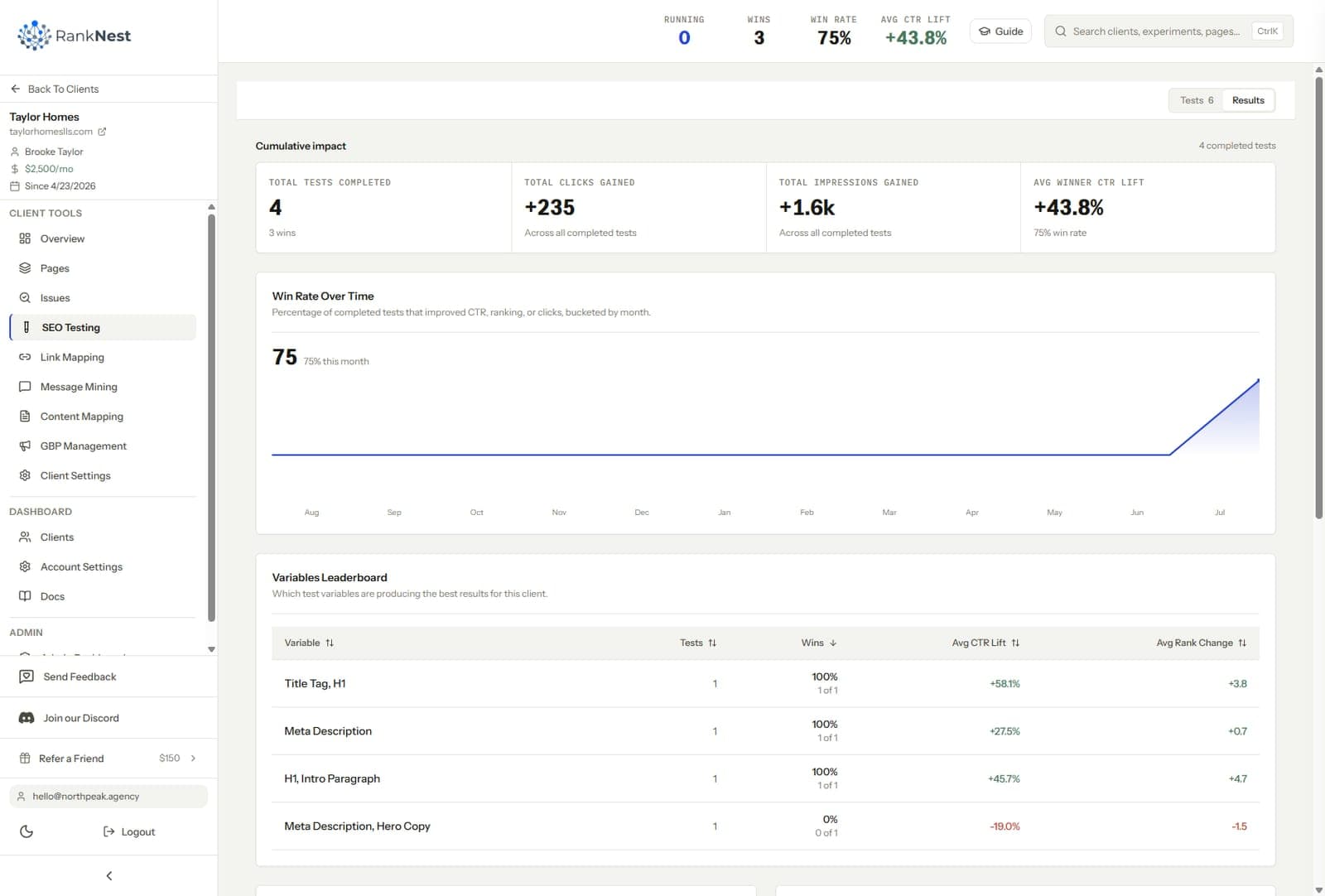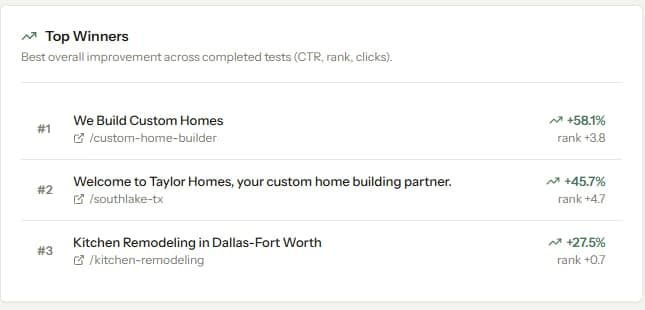
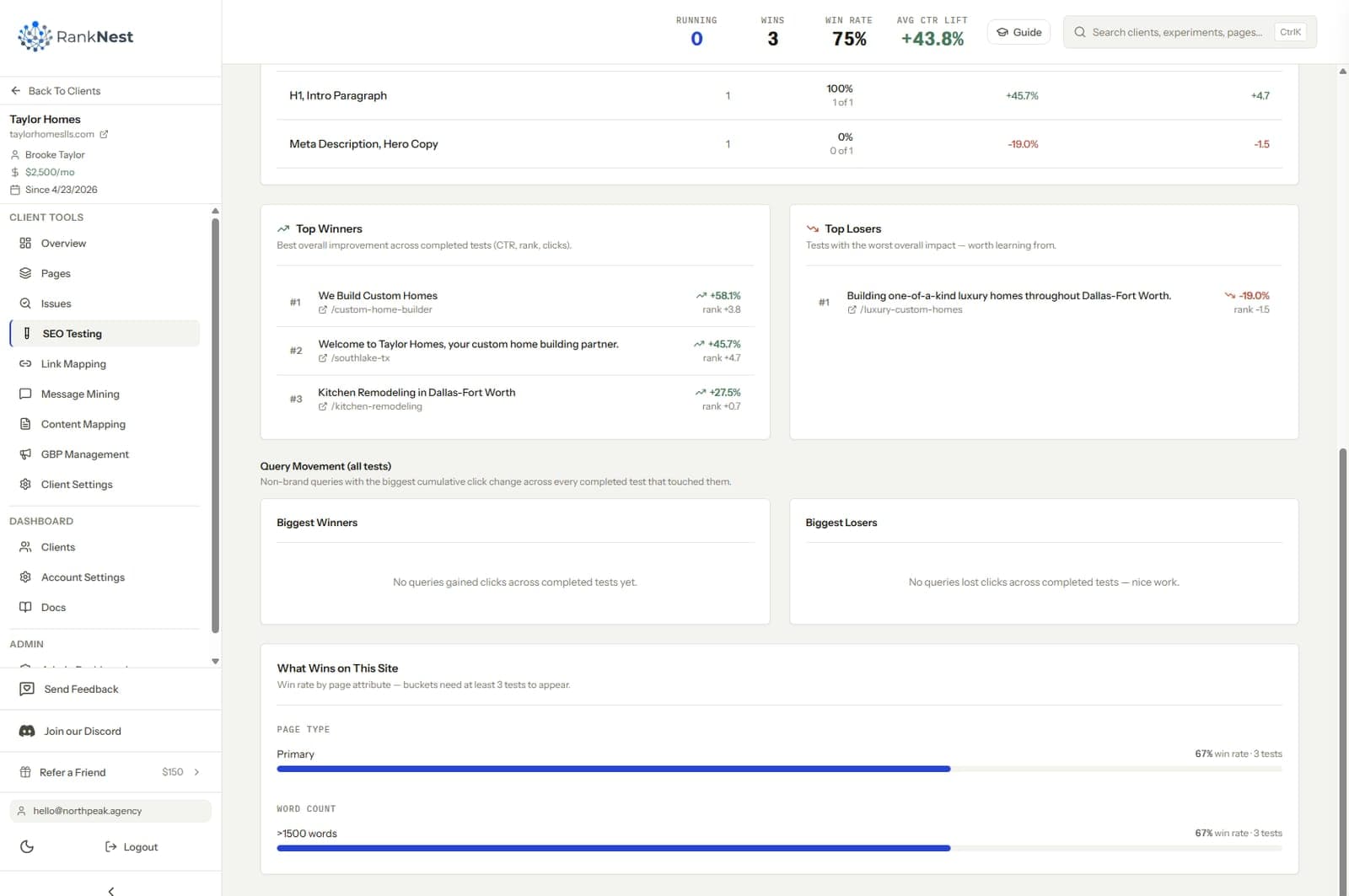
The best SEO tests on client sites are single, reversible changes measured against a Google Search Console baseline. Start with metadata and internal links, which ship in minutes and read out in about a month, then graduate to content and technical tests. Below are 25 ideas sorted by effort and risk, each with a hypothesis, a way to measure it, an expected timeline, and a line you can use to pitch it to the client.
If you have never run a structured test before, read our complete guide to SEO testing for agencies first. It covers baselines, windows, and confounds. Every idea below assumes the same discipline, one change per page, exact date recorded, before/after comparison against the site-wide trend. We built RankNest's experiment workflow to sync the GSC baseline and show the delta automatically, though a spreadsheet works fine to start.
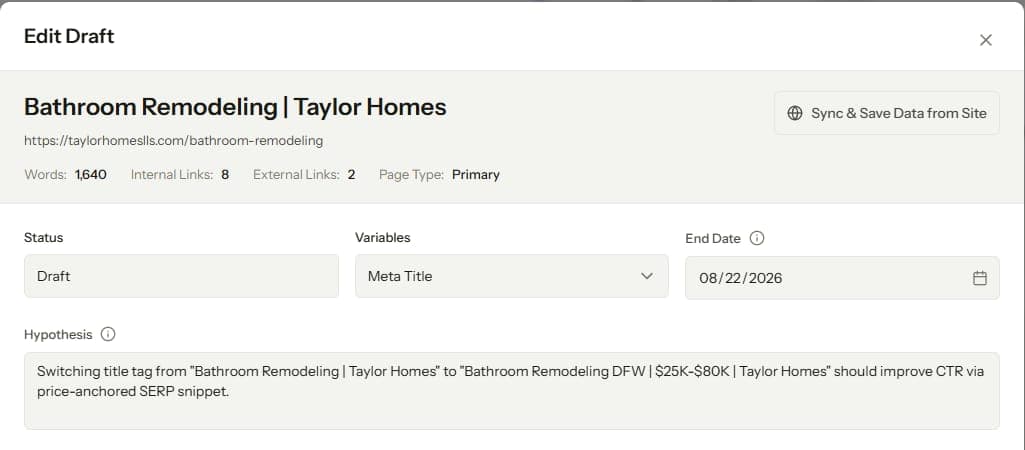
Low effort, low risk: title and snippet tests
1. Front-load the primary keyword in the title tag
Hypothesis. Moving the main query to the start of the title lifts CTR on pages ranking 4 through 10. Measure. CTR for the page's top query in GSC, before/after, position held roughly constant. Timeline. 4 weeks after recrawl. Client pitch. "Your page already ranks, we want more of the people who see it to click it."
2. Add a number or spec to the title
Hypothesis. A concrete number, a price, a count, a timeframe, makes the listing more clickable than a generic title. Measure. Page CTR in GSC over matched 28-day windows. Timeline. 4 weeks. Client pitch. "Specifics win clicks, we are testing whether '7 signs' beats 'signs' for your page."
3. Add the current year to a time-sensitive title
Hypothesis. Queries with freshness intent click titles that signal current information. Measure. CTR and position for the page's freshness-flavored queries. Timeline. 4 weeks, then a reminder to retest at year end. Client pitch. "Searchers want current answers, we are testing whether saying so wins the click."
4. Rewrite the meta description as a direct answer
Hypothesis. A description that answers the query in plain words outperforms boilerplate marketing copy. Measure. Page CTR in GSC. Check the SERP to confirm Google is actually using your description. Timeline. 4 weeks. Client pitch. "This is your ad in the search results, right now it is not selling anything."
5. Align the H1 with the real query, not the brand's phrasing
Hypothesis. Matching the H1 to the language searchers use improves relevance and position for the target query. Measure. Average position for the target query, 6 weeks before and after. Timeline. 6 weeks. Client pitch. "Customers search 'water heater repair', your page says 'hydro solutions', we are testing the plain version."
6. Rewrite the first paragraph as a snippet-ready answer
Hypothesis. A 2-3 sentence direct answer at the top wins featured snippets and AI citations for question queries. Measure. Snippet ownership for target queries, plus impressions and position. Timeline. 4 to 8 weeks. Client pitch. "We are rewriting your opener so Google can quote it above every competitor."
7. Add an FAQ section to a service page
Hypothesis. Answering the questions people actually ask expands the query set the page ranks for. Measure. Query count and total impressions for the page in GSC. Timeline. 6 to 8 weeks. Client pitch. "Every question your front desk answers by phone is a search we can capture on this page."
8. Add structured data to a key template
Hypothesis. Valid schema, Product, LocalBusiness, or Article, earns richer results and lifts CTR. Measure. CTR on affected pages, plus Search Console's enhancement reports for eligibility. Timeline. 6 weeks. Needs template access, so queue it with the client's developer. Client pitch. "This markup makes your listing show prices and ratings where competitors show plain text."
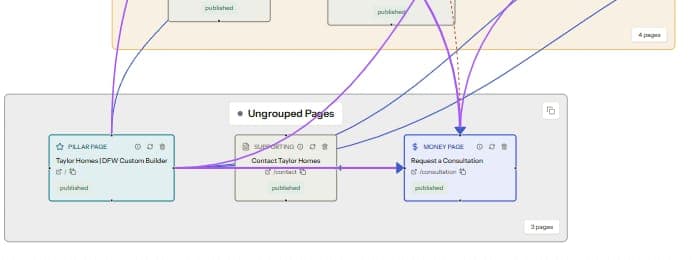
Low effort, low risk: internal linking tests
Internal link tests are the most agency-friendly ideas on this list. They need no dev queue, they are reversible in minutes, and most client sites have never had them done deliberately. A visual map of the client's link graph makes picking targets much faster, because underlinked money pages jump out on sight.
9. Add 3 to 5 internal links to an underperforming page
Hypothesis. Links from relevant established pages raise the target page's position for its main query. Measure. Average position and clicks for the target page over 6 to 8 weeks. Timeline. 6 to 8 weeks. Client pitch. "Your best page is buried, we are pointing your site's authority at it."
10. Swap vague anchors for descriptive ones
Hypothesis. Replacing 'click here' and 'learn more' with descriptive anchors clarifies relevance and improves the target's position. Measure. Target page position for the query the anchors now describe. Timeline. 6 weeks. Our anchor text best practices cover how to vary phrasing safely. Client pitch. "Every link is a signpost, right now half of yours are blank."
11. Link from the site's highest-traffic page to a money page
Hypothesis. One link from the client's strongest page moves rankings more than 5 links from weak pages, and passes referral clicks too. Measure. Target page position and clicks, plus referral traffic from the source page in GA. Timeline. 4 to 6 weeks. Client pitch. "Your blog post gets 5,000 visits a month and sends zero of them toward a sale, we are fixing that."
12. Rescue an orphan page
Hypothesis. A page with zero internal links gains impressions once crawlers and users can reach it. Measure. Impressions, clicks, and crawl stats for the orphan, from near-zero baselines. Timeline. 4 to 8 weeks. Client pitch. "You paid for this page and your own website does not link to it once."
13. Add a hub link block to cluster pages
Hypothesis. Linking sibling pages in a topic cluster to each other and to the pillar lifts the whole cluster's positions. Measure. Combined impressions and average position across the cluster, versus the site trend. Timeline. 8 weeks. Client pitch. "Your guides act like strangers to each other, connected they rank as a group."
14. Trim sitewide footer links
Hypothesis. Cutting dozens of low-value footer links concentrates signals on the links that remain. Measure. Positions for the pages that keep their footer links, watched over 8 weeks. Revert if key pages dip. Timeline. 8 weeks. Slightly higher risk, snapshot everything first. Client pitch. "Your footer links to 40 pages, which tells Google none of them matter."
Medium effort: content tests
15. Refresh a decaying post
Hypothesis. Updating facts, screenshots, and dates on a post that lost traffic year over year recovers its position. Measure. Clicks and position versus the same period last year rather than last month. Timeline. 6 to 8 weeks. Client pitch. "This post earned 800 visits a month in 2024 and 300 now, a one-day refresh can win that back."
16. Expand a page to match the ranking intent
Hypothesis. Adding the sections top-ranking competitors cover, and the page lacks, closes the relevance gap. Measure. Position for the main query, plus new query impressions in GSC. Timeline. 8 weeks. Client pitch. "Every page outranking you covers pricing and process, your page covers neither."
17. Consolidate two cannibalizing pages
Hypothesis. Merging two pages that trade rankings for one query produces one stronger page that ranks higher than either. Measure. Combined clicks and the ranking URL's position, watched for stability after the redirect. Timeline. 8 to 12 weeks. Moderate risk, keep a copy of both originals. Client pitch. "You are competing against yourself for this keyword, and both pages are losing."
18. Add a comparison table
Hypothesis. A clean table on a commercial page wins comparison-intent queries and table-style snippets. Measure. Impressions and position for 'vs' and 'best' queries on the page. Timeline. 6 weeks. Client pitch. "Shoppers comparing options get a table from your competitor and 12 paragraphs from you."
19. Cut the intro to under 50 words
Hypothesis. Getting to the answer faster improves engagement and holds rankings held by bloated pages. Measure. Position and CTR, plus engagement time in GA4 as a secondary signal. Timeline. 6 weeks. Client pitch. "Nobody scrolls past 300 words of throat-clearing, we are leading with the answer."
20. Publish real pricing on a service page
Hypothesis. Pages that state prices, even ranges, match query intent better and convert more qualified clicks. Measure. Position for 'cost' and 'price' queries, plus lead quality feedback from the client. Timeline. 6 to 8 weeks. The hard part is convincing the client, the test frame helps. Client pitch. "People search your service plus 'cost' hundreds of times a month, right now competitors give the answer."
Higher effort: structural and technical tests
21. Add breadcrumbs with schema
Hypothesis. Breadcrumb navigation with markup clarifies site structure and improves the SERP display. Measure. CTR on affected templates and breadcrumb eligibility in Search Console. Timeline. 8 weeks, needs a developer. Client pitch. "This shows Google, and searchers, exactly where each page sits in your site."
22. Cut response time on one template
Hypothesis. Faster server response on a heavy template improves crawl efficiency and user metrics on those pages. Measure. Response times in your crawler, Core Web Vitals field data, positions on the template's pages over 8 to 12 weeks. Timeline. 8 to 12 weeks. Client pitch. "Your category pages take 4 seconds to answer, we think that is costing rankings, so we will measure it."
23. Prune thin archive and tag pages
Hypothesis. Noindexing dozens of near-empty tag pages focuses crawling and indexing on pages that earn traffic. Measure. Indexed page count, crawl stats, and clicks to remaining pages over 12 weeks. Timeline. 12 weeks. Higher risk, verify the pruned pages truly earn nothing first. Client pitch. "A third of your indexed pages are empty tag archives, they dilute the pages that make you money."
24. Reduce click depth to a key page
Hypothesis. Moving a buried page from 5 clicks deep to 2 raises its crawl frequency and position. Measure. Crawl frequency in the server logs if available, plus position and impressions over 8 weeks. Timeline. 8 weeks. Client pitch. "If it takes 5 clicks to find this page, Google treats it as 5 clicks unimportant."
25. Add an author bio and last-updated date to advice content
Hypothesis. Visible credentials and honest dates improve trust signals on content where expertise matters. Measure. Position and CTR across the affected articles, versus untouched articles as an informal control. Timeline. 8 to 12 weeks. Client pitch. "Your advice pages are anonymous, we are putting your license number and your face on them."
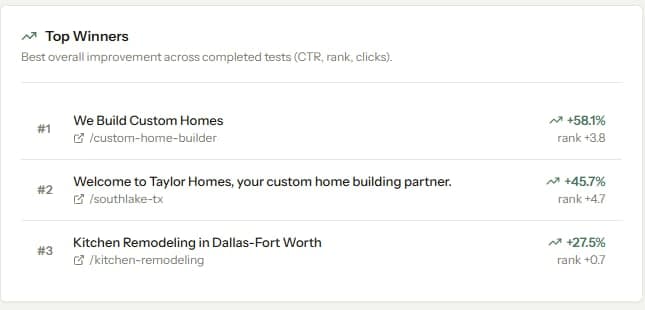
How to sequence these across a client roster
Do not run all 25 on one site. Pick 2 or 3 per client per month, drawn from the shortlist of pages with real impression volume, and let windows finish before you touch tested pages again. Ideas 1, 4, 9, and 11 are the usual openers because they ship in under an hour and read out in about a month. For smaller clients, the same ideas are easier to read when you use SEO tests on small sites and compare each change against the site's own trend.
The compounding move is cross-client repetition. When idea 2 wins on three roofing clients, it stops being a test and becomes your roofing playbook, which is the fastest way an agency builds evidence no competitor has.
FAQ
What should you test first on a new client site?
Title tag tests on pages ranking in positions 4 through 15 with high impressions and low CTR. They cost nothing to ship, revert in minutes, and usually show a readable CTR delta within 4 weeks. Internal link additions to an underlinked money page are the natural second test.
How many SEO tests can you run on one site at once?
As many as you can keep isolated, meaning no two tests touch the same page or the same query set. On a small site that usually caps out at 2 or 3 concurrent tests. Overlapping tests destroy attribution, which defeats the point.
How long does an SEO test take to show results?
Metadata and CTR tests typically read out in 4 weeks after recrawl. Internal linking and content tests need 6 to 12 weeks, and technical tests can take a full quarter. Low-traffic pages always need the longer end of the range.
Do these SEO experiments work on low-traffic sites?
Yes, with longer windows and tempered expectations. A page with 50 clicks a month needs 8 to 12 weeks to show a trustworthy delta, and single results carry less certainty. Repeating the same test across several similar clients is how small-site agencies build confidence.
What is a good SEO test hypothesis?
One sentence naming the change, the metric, and the expected direction. For example, front-loading the keyword in this title will raise the page's CTR from 1.2 percent toward 2 percent within 4 weeks. If you cannot name the metric, the idea is not ready to test.